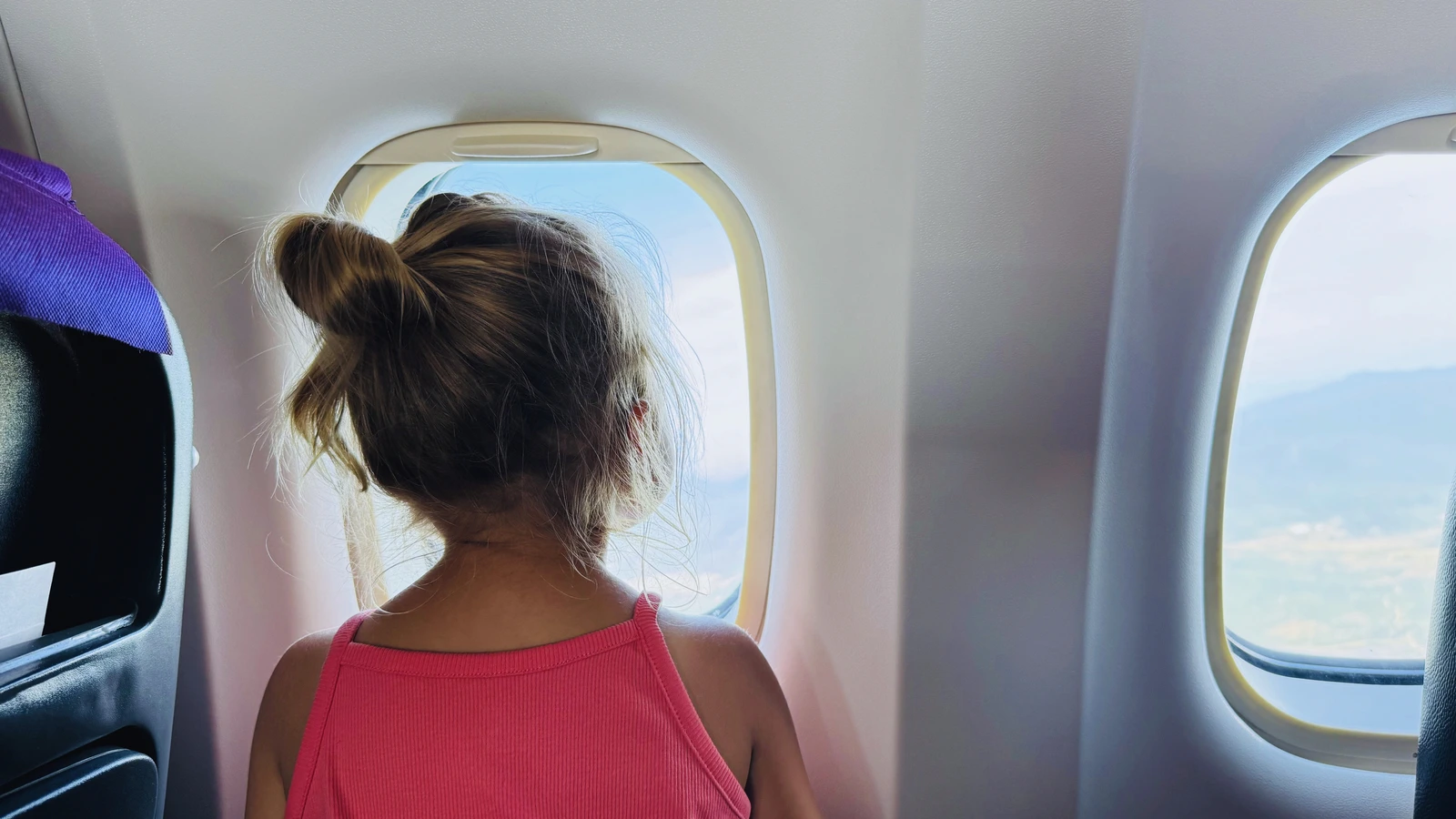
Flying with a toddler on a long haul flight can feel overwhelming, but good preparation makes a huge difference. In our experience, the most important things are bringing enough snacks and activities, staying flexible, and not expecting every part of the flight to go smoothly

Quick Summary: Flying with a Toddler
In this guide, we’ll go through the whole journey step by step: from preparing before the flight to airport survival, sleeping on the plane, entertainment, landing, and dealing with jet lag after arrival.
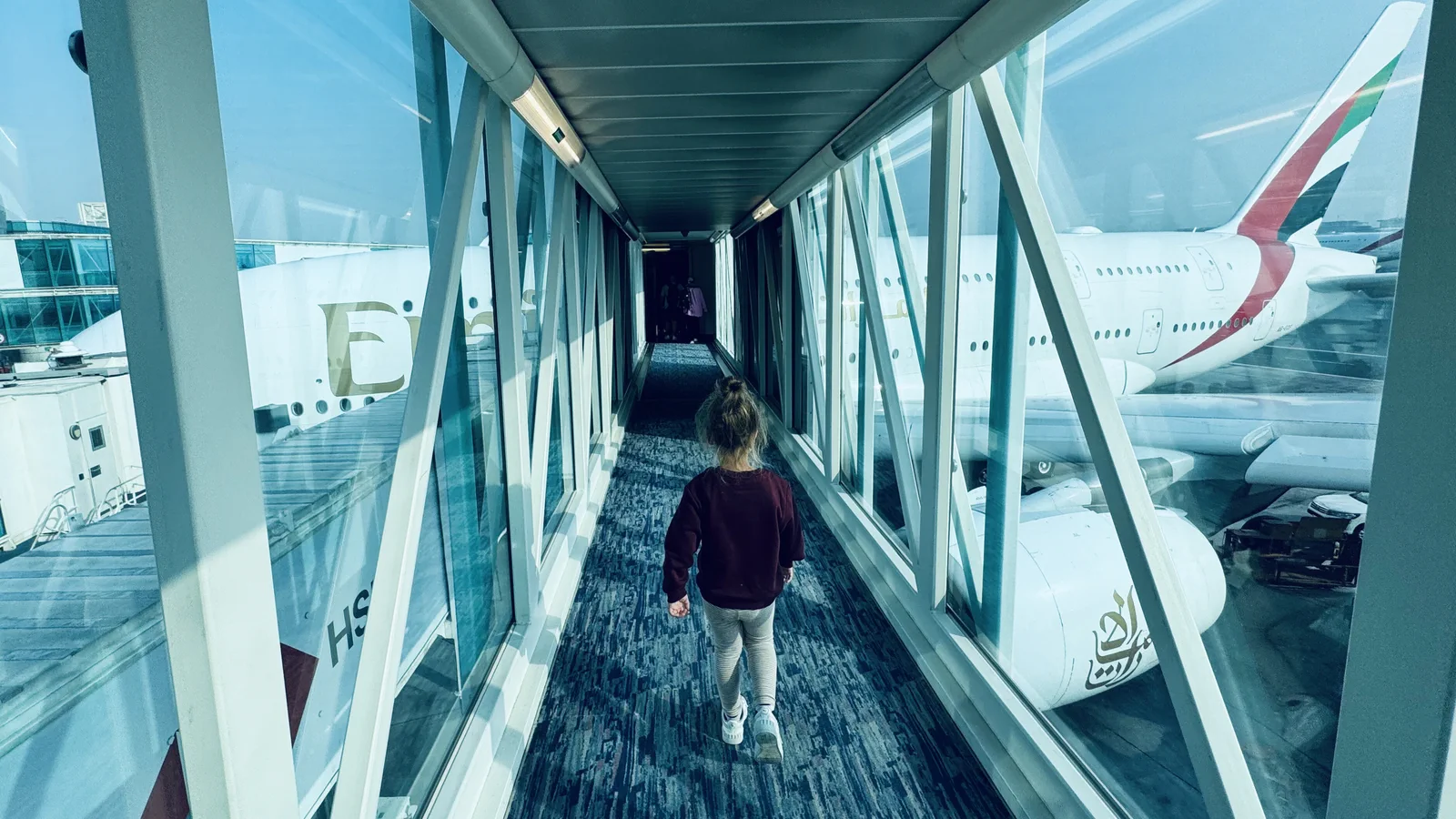
We’ve taken quite a few long flights with our kids now, from the baby stage up to age 5. Most of our bigger trips were long haul flights to places like Thailand with kids and Indonesia with kids, so we’ve learned a lot by actually doing it.
And honestly, we learned a lot by doing it wrong first.
On our first long flights with our kids, we were much more focused on sleep. We tried hard to make naps happen, worried about routines, and felt tense whenever things didn’t go the way we hoped. Over time, we learned that flying with toddlers became easier when we stopped trying to control every part of the flight.
What helped us most was staying calm, lowering our expectations a little, and accepting that some parts of the flight would simply be easier than others. Snacks, movement breaks, screen time, stickers, cuddles, random little games, another snack, maybe sleep, maybe no sleep.
We also remember how stressful those first flights felt because you’re so aware of everyone around you. If your child cries, you immediately wonder what other passengers are thinking. But in our experience, most people were kind, patient, or simply busy with their own flight.
We’ve had smooth flights, difficult flights, and on our most recent long haul flight, our daughter even got sick on the plane. So this guide isn’t based on one perfect travel day. It’s based on what actually helped us during real international flights with young kids.
Affiliate disclosure: We only recommend places and services we’d use ourselves. Some links on this page are affiliate links, which may earn us a small commission at no extra cost to you.
Flying with a toddler starts before you even arrive at the airport. The more you can arrange at home, the less you have to figure out while carrying bags, passports, snacks, and probably at least one tired child.
For us, the goal is not to plan every minute of the flight. It’s more about removing small stress points before travel day, so the actual journey feels a little calmer.

Quick overview: how to prepare for flying with a toddler
- 🕒 Choose your flight time carefully if you can
- 💺 Reserve your seats early
- 🧾 Arrange check-in, parking and documents before travel day
- 🎒 Keep your toddler’s own backpack light
- 👜 Pack one main kids’ carry-on bag
- 🍿 Prepare snacks, downloads and headphones
- 👶 Decide on a stroller or carrier strategy
- 😴 Don’t overthink sleep before the flight
Day Flight or Overnight Flight with a Toddler?
If you have a choice, think carefully about the timing of your long haul flight. We’ve done both day flights and overnight flights with our kids, and for long haul trips, overnight flights usually work best for us.
That doesn’t mean our kids sleep the whole way. They don’t. But on a night flight, there is at least a bigger chance they will sleep for part of the journey. Even a few hours of sleep can make a long flight feel much more manageable.
For shorter flights, we usually prefer flying during the day. But for long haul flights with toddlers, we personally like flights that fit some kind of natural sleep rhythm.
When comparing flights, we now look at more than just the route or price. We also think about:
- Departure time: Will the kids already be exhausted before we board?
- Layover time: Is there enough time to get through the airport without rushing?
- Arrival time: Will the first day be somewhat manageable?
- Airport: Is the layover airport easy with kids?
We don’t always get the perfect flight. Sometimes price, availability, or route options decide for you. But if there are several options, we do look beyond the ticket price now. A slightly better flight time can make the whole journey feel much easier with young kids.
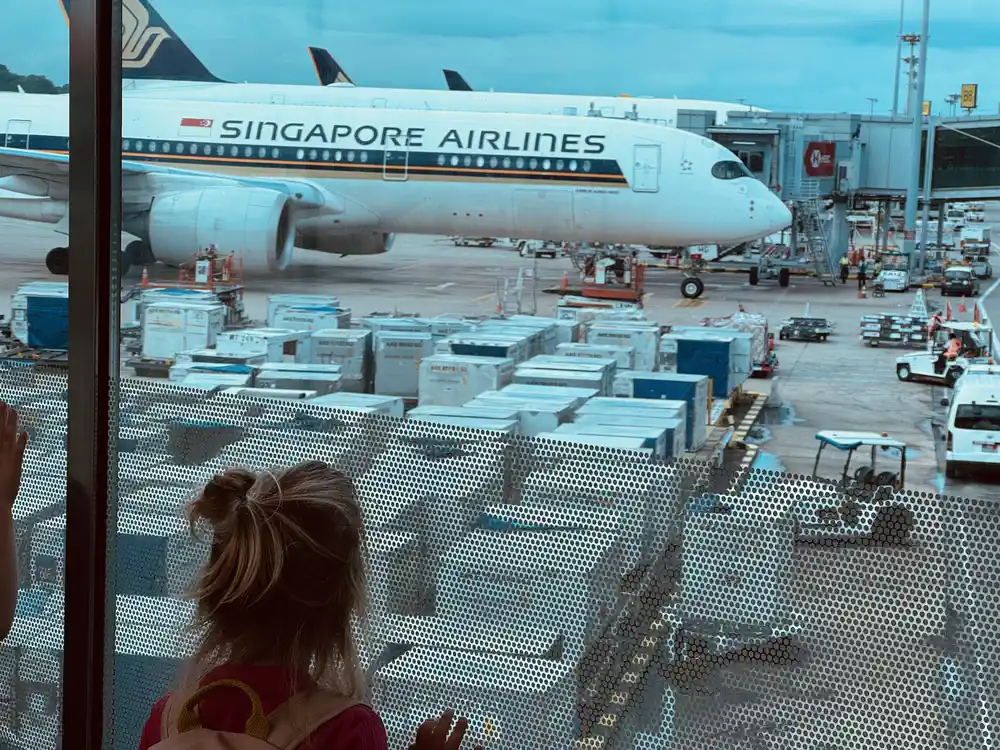
Arrange Check-In, Documents and Downloads Before Travel Day
This is not the most exciting part of family travel, but it helps. Before a long haul flight with toddlers, we try to arrange as many practical things as possible before we leave home.
Think about online check-in, seat reservations, airport parking or transport, passports, travel documents, travel insurance, downloads, snacks, and a few activities.
It sounds basic, but these are exactly the things you don’t want to be sorting out at the airport with young kids. If we can make the travel day a little more boring and predictable, that is usually a good thing.
💡 Crew Tip: If it’s one of your child’s first flights, it can also help to talk about the airport and airplane at home beforehand. A simple book, pretend play, or looking at airplane pictures can make the whole experience feel more familiar.
Choose the Best Airplane Seats for Your Family
Seat choice can make a big difference when flying long haul with kids, mostly because sitting together makes everything calmer. With many airlines, there is no full guarantee that your whole family will automatically be seated together unless you reserve seats in advance. So for peace of mind, it can be worth paying extra to lock in your seats.
Some airlines are better with this than others. For example, with Singapore Airlines, we were able to choose seats for free when flying with kids.
When we fly as a family of four, we usually keep it simple. If the plane has a 3-3 or 3-3-3 layout, we often choose three seats together with one parent across the aisle. If there is a row of four in the middle, we prefer sitting all together.
We’ve also had bulkhead seats before. The extra space can be really nice, and with a baby, you may need the bulkhead row if you want to use the airplane bassinet.
But with toddlers, bulkhead seats are not always perfect. The armrests often don’t lift, which can make sleeping across seats harder. You also usually can’t keep your bag at your feet during takeoff and landing.
So our opinion is: bulkhead seats can be great with a baby, but they are not automatically the best option with toddlers. It depends on your child, the airline, and whether you prefer extra floor space or more flexible seats.
What to Pack in Your Toddler’s Backpack
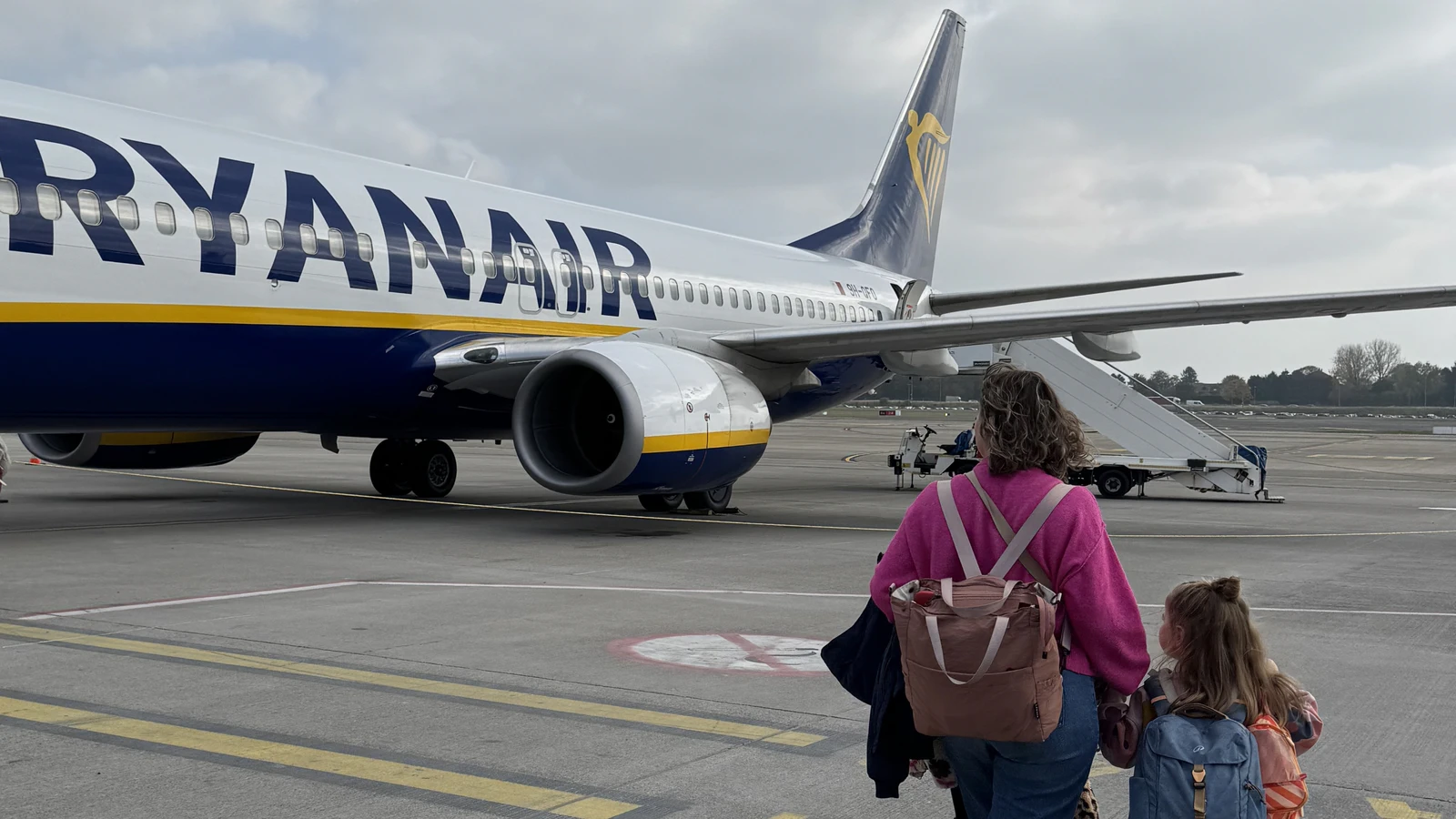
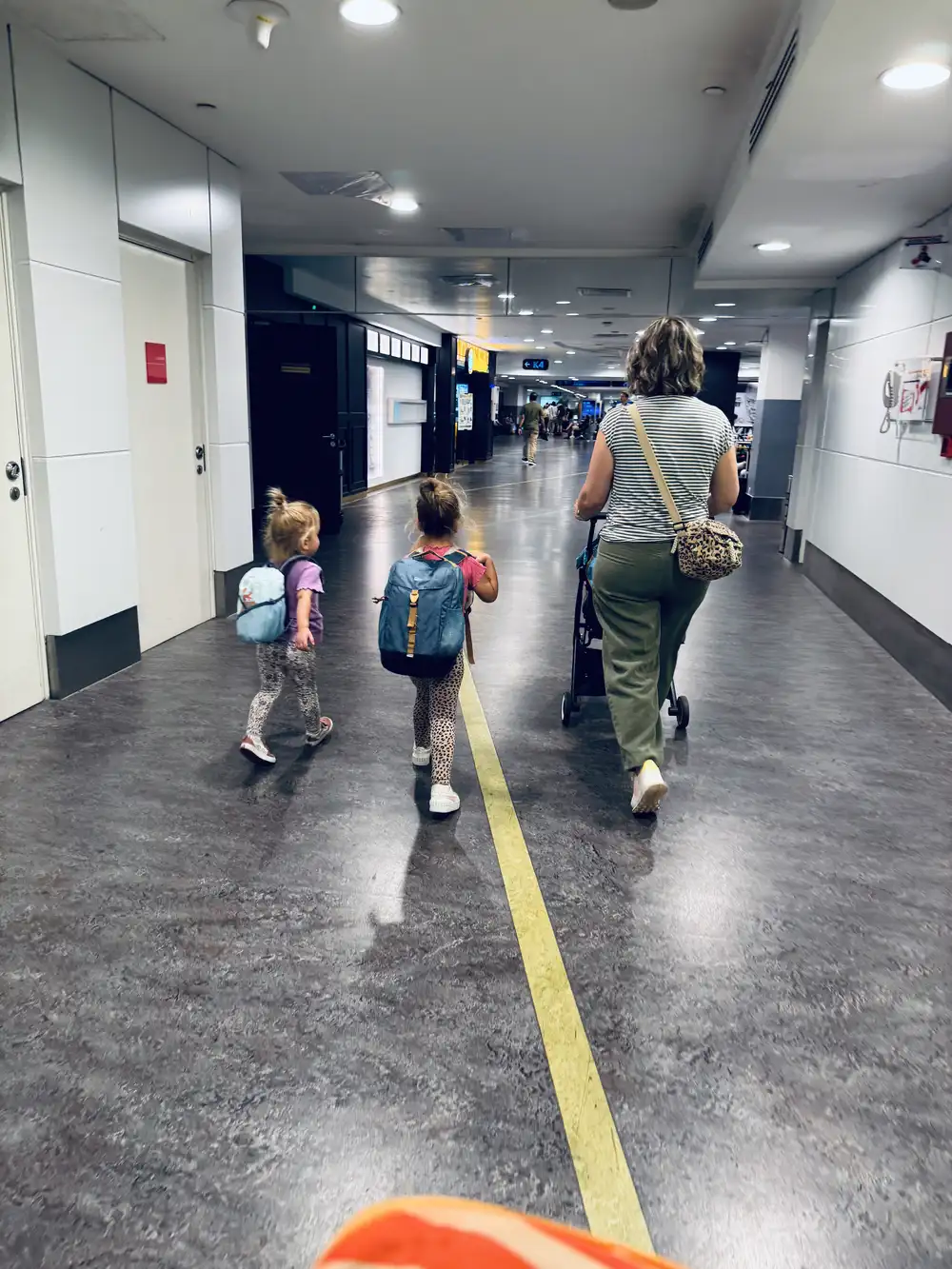
We usually give both kids their own small backpack with a few of their own things inside. They like having something that feels theirs, and it makes the airport part a bit more fun.
But we keep it light, because there is a good chance you will end up carrying it yourself at some point.
For us, the toddler backpack is not the main activity bag. It’s more for a few personal things, like a small toy, a comfort item, a snack, stickers, or one little surprise.
Ride-on suitcases are popular and can be useful for some families. But they can also be annoying in busy airports, especially if your child gets tired, refuses to ride, or you suddenly have to carry the suitcase as well. For us, a small backpack is usually the easiest option.
What to Pack in Your Carry-On When Flying with a Toddler
Instead of spreading everything across too many bags, we like having one main kids’ carry-on bag with the things we need during the flight.
Inside that bag, we group things together as much as possible. For example, we might have a small changing pouch with diapers, wipes and cream, a spare clothes pouch, snacks, tech items, and a few activities. That way, if one of us takes a child to the toilet, we can just grab the changing pouch instead of dragging the whole bag with us.
Things we usually want easy access to:
- Snacks and small meals
- Wipes and diapers if needed
- Spare clothes
- Headphones
- iPad or tablet
- Chargers and cables
- A few simple activities
- Comfort items
- Passports and travel documents
- Water bottle
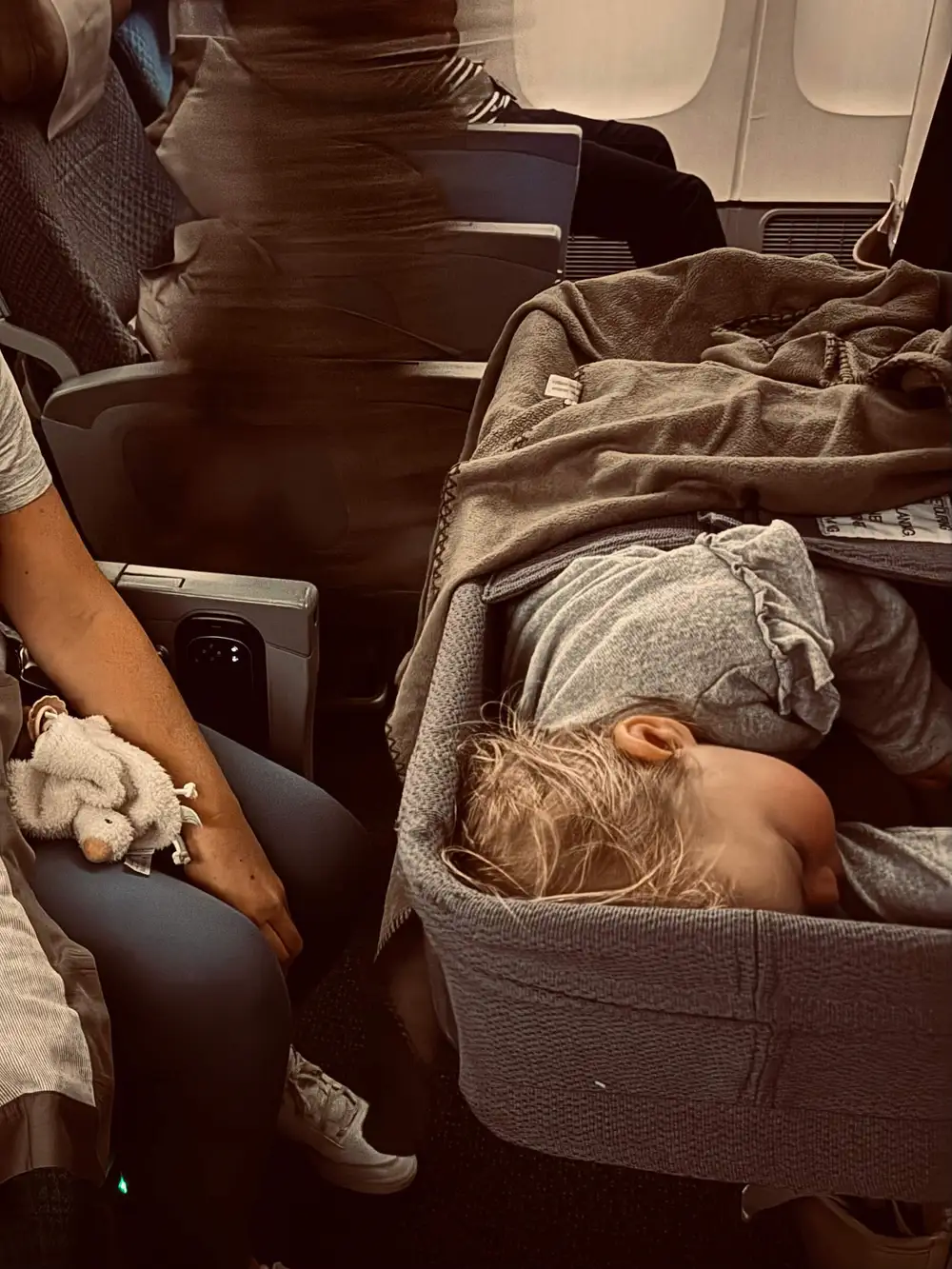
One thing that has worked really well for us on long haul flights is an inflatable airplane bed or footrest. It can make it much easier for young kids to stretch out, rest their legs, or sleep more comfortably. Just make sure to check your airline’s rules before bringing one, because not every airline allows them.
If you want a more detailed list, you can also read our full carry-on packing list for kids or download our free carry-on packing list before your next trip.
Stroller or Carrier for the Airport?
This really depends on your child, your airport, your destination, and how much walking you expect to do.
We’ve traveled with two strollers, with one stroller and one carrier, and on our latest trip with only a carrier. All of those options can work, but it helps to decide before travel day.
A stroller is useful if your toddler still naps in it, gets tired easily, or if you’ll need it at your destination anyway. Our favorite travel stroller is the Cybex Libelle, because it folds very small and is designed to fit in many airplane overhead compartments. Always check your airline’s cabin baggage rules before relying on that, though.
A carrier can be just as useful, especially during short layovers, long walks through big airports, immigration, baggage claim, or late-night arrivals. If your child is exhausted and you suddenly need to move quickly, having a carrier can be a lifesaver. We like the Tula Explore carrier for this.
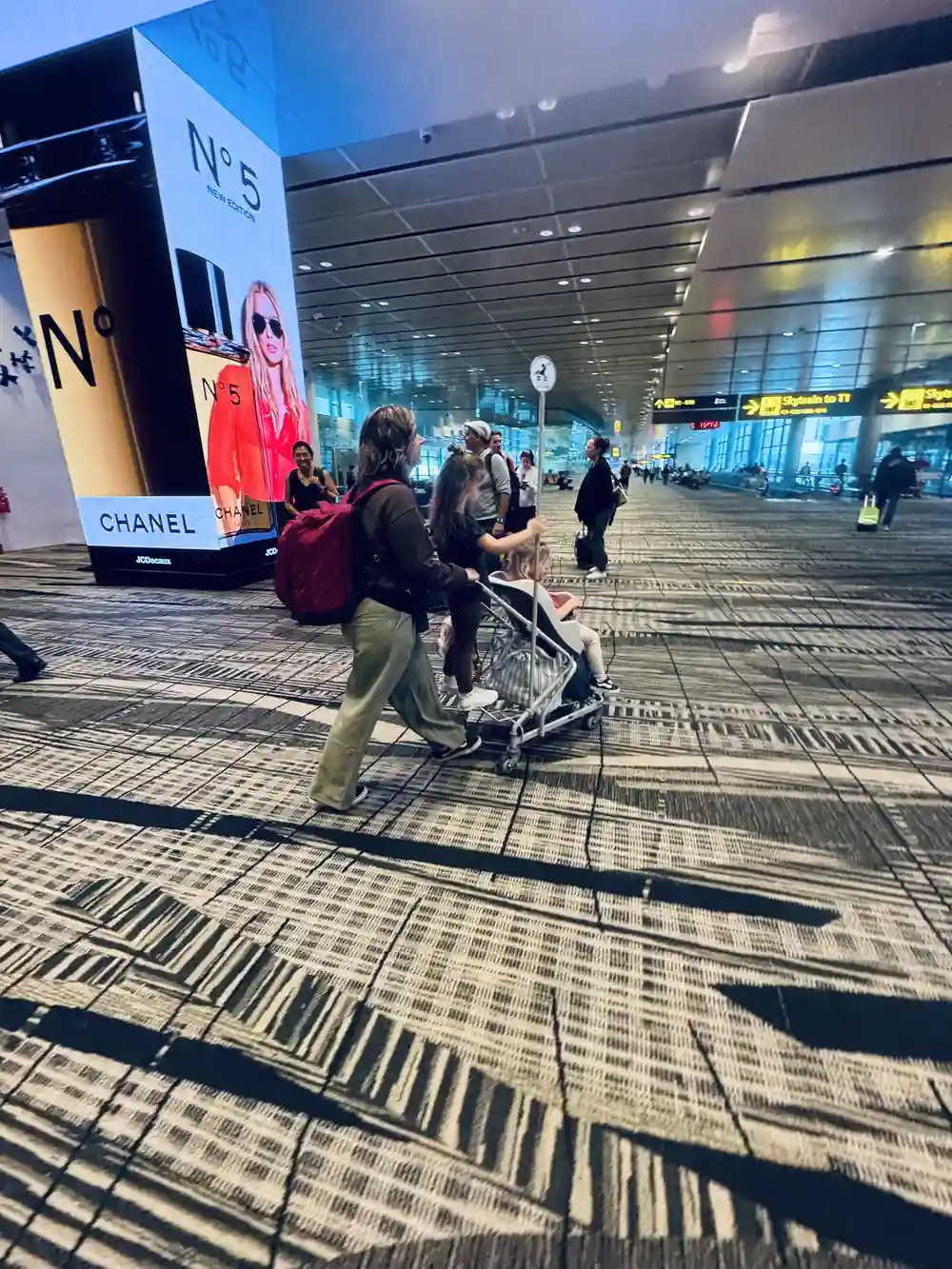
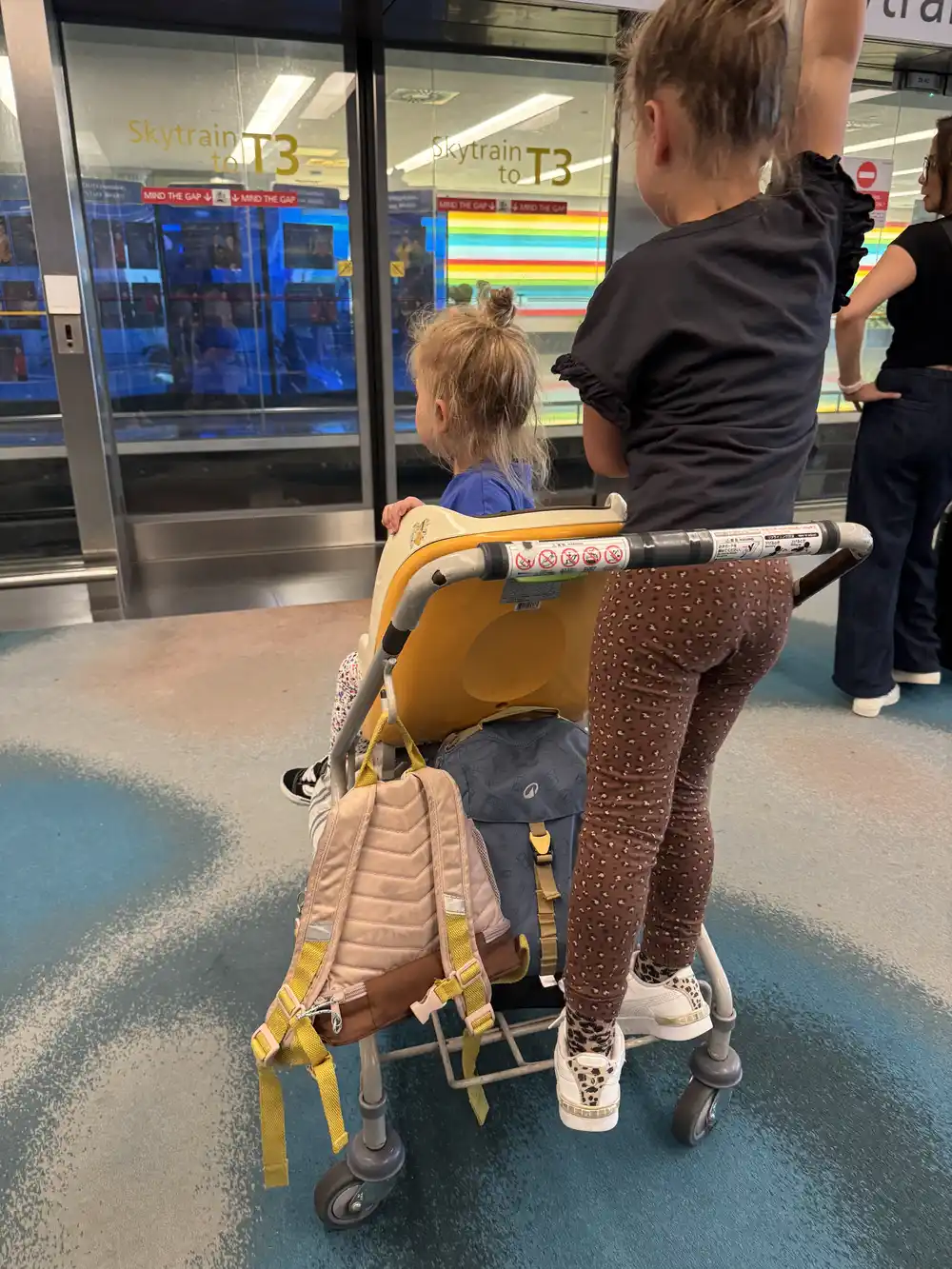
Some airports, like Singapore and Dubai, also have strollers available inside the airport, which can be helpful if you don’t want to bring your own. But we still like having at least one option ourselves, either a stroller or a carrier, especially for transfers or tired moments.
Our advice: bring at least one way to move quickly with a tired toddler. Whether that is a stroller or carrier depends on your child and your trip, but having nothing can make a long airport walk feel very long.
Should You Adjust Your Toddler’s Sleep Before a Flight?
We used to think much more about sleep before flying with toddlers. Should we shift bedtime, skip a nap, or try to make the kids extra tired before the flight?
Now, we don’t try to control it too much.
For overnight flights, we do try to keep the day calm and avoid starting the flight with a completely overtired child. But we don’t force a big schedule change. With toddlers, sleep is unpredictable anyway, and travel adds excitement.
What helps more is keeping things familiar and relaxed. A favorite stuffed animal, a pacifier if your child uses one, and a simple bedtime rhythm can help. But we wouldn’t build the whole flight plan around sleep.
Your toddler might sleep. They might not. Preparing for both options is usually the safest plan.
When flying with a toddler, the airport is the last place where they can move, eat, explore a little, and get ready before sitting on the plane for hours.
Airports can feel stressful with young kids, but they can also work in your favor. There is space to walk, things to look at, and sometimes even a small play area where kids can burn off some energy before boarding.
Quick overview: airport with a toddler
- 🍽️ Eat something before you board
- 🛝 Look for a play area or space to move
- 🧸 Keep one airport activity ready
- 🛫 Board early and get settled
- 👶 Bring a cabin-size stroller if you can
Eat Before You Board if You Can
If there is enough time, we try to eat something before getting on the plane. It doesn’t have to be a big meal, but having something decent before boarding can really help.
Airplane food can be hit or miss with kids. Sometimes they like it, sometimes they barely touch it. And on long haul flights, meal timing doesn’t always match your toddler’s hunger.
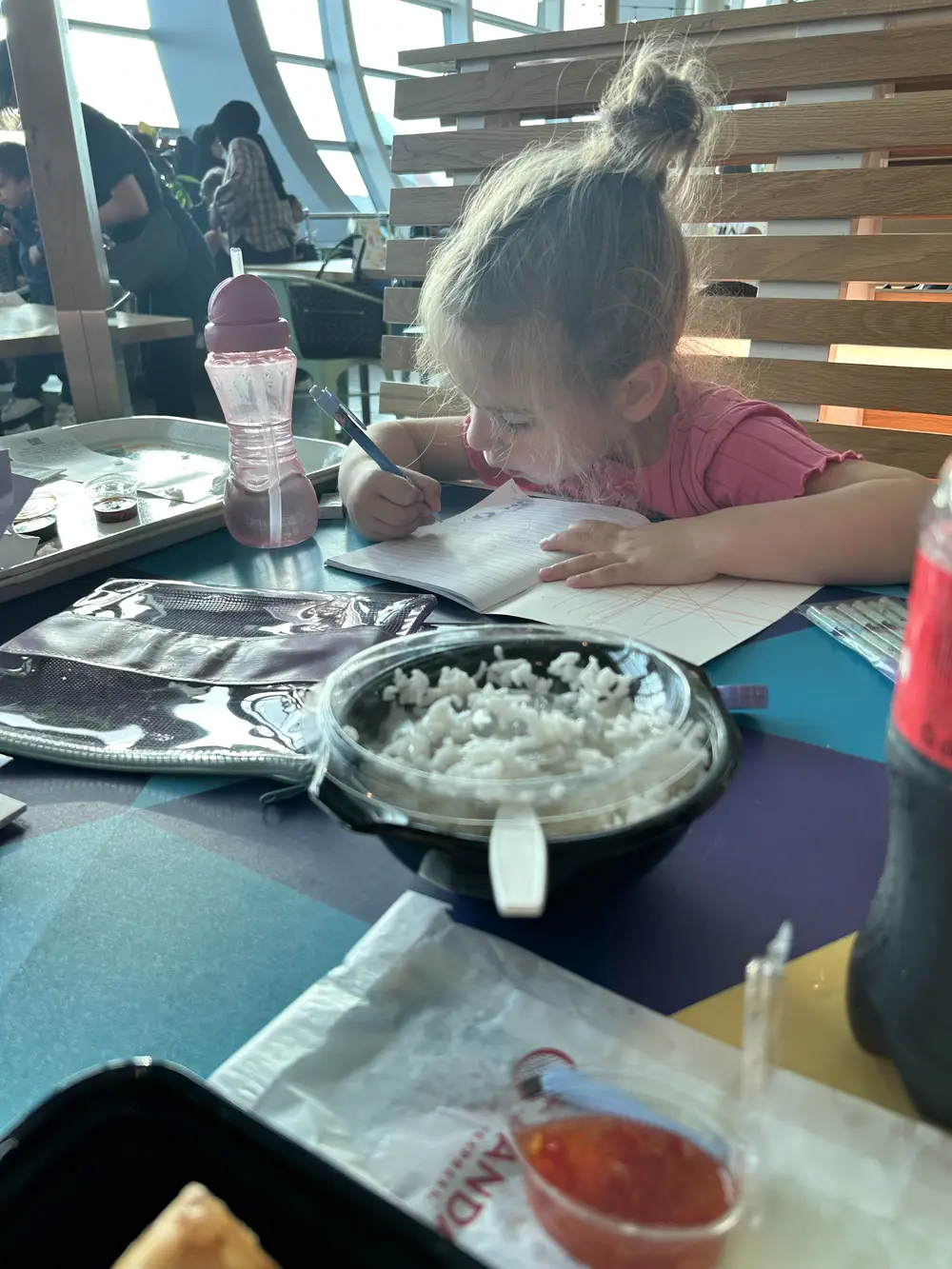
So if we can, we try to make sure the kids have eaten something familiar before the flight. And yes, sometimes that means airport McDonald’s. A toddler who has already eaten a little is usually easier than a toddler waiting for airplane food they may not like.
We also try not to use all the best snacks before boarding. Snacks are little reset moments on a long flight, so we save the more exciting ones for takeoff, waiting on the plane, or difficult moments during the flight.
Find a Play Area or Space to Move
Before a long flight, we try not to make our kids sit still for too long at the airport. They are going to sit enough on the plane.
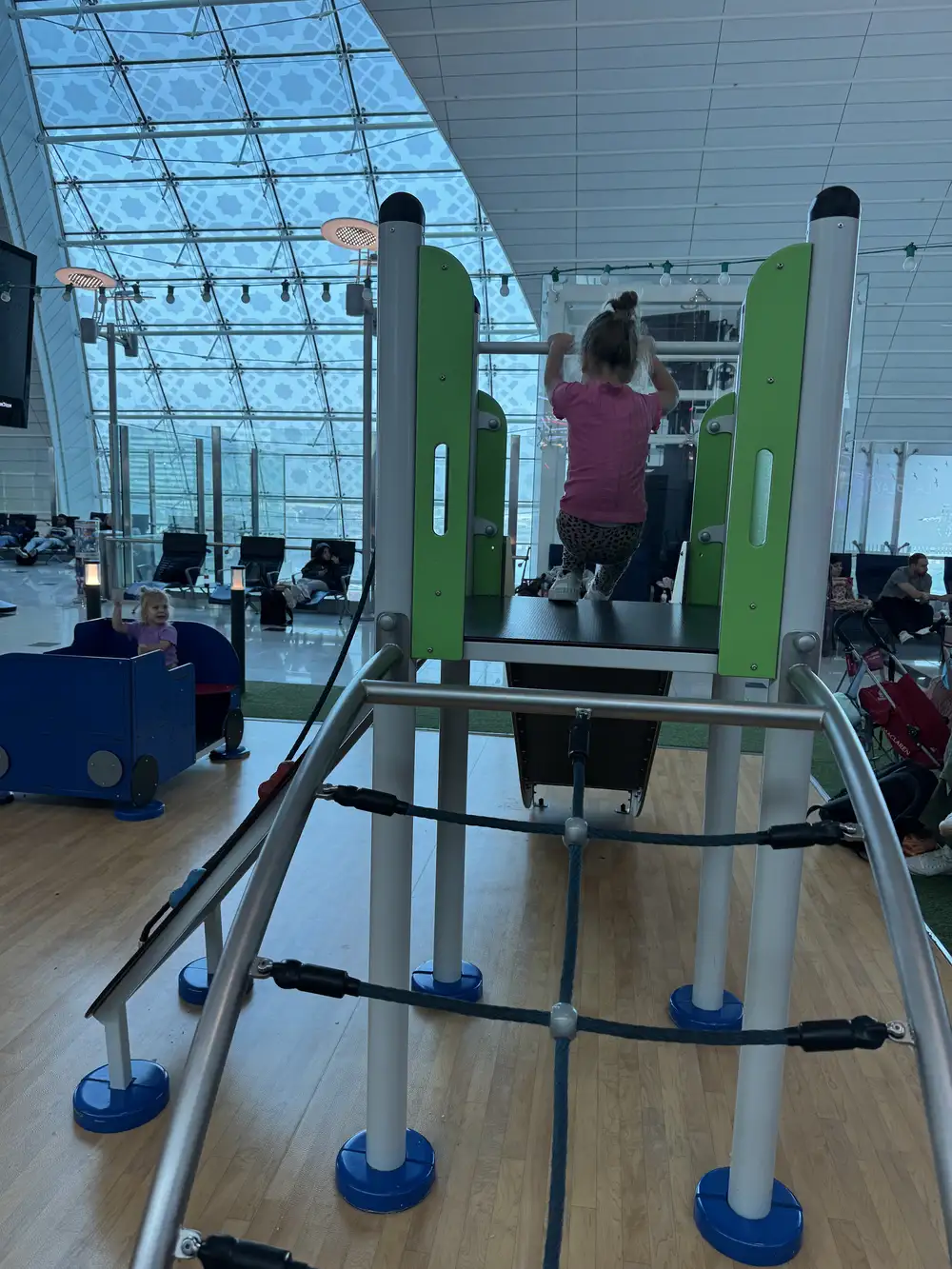
If the airport has a small play area, we always try to find it. Many bigger airports have some kind of kids’ area, and even a simple space to climb, walk, or move around can help.
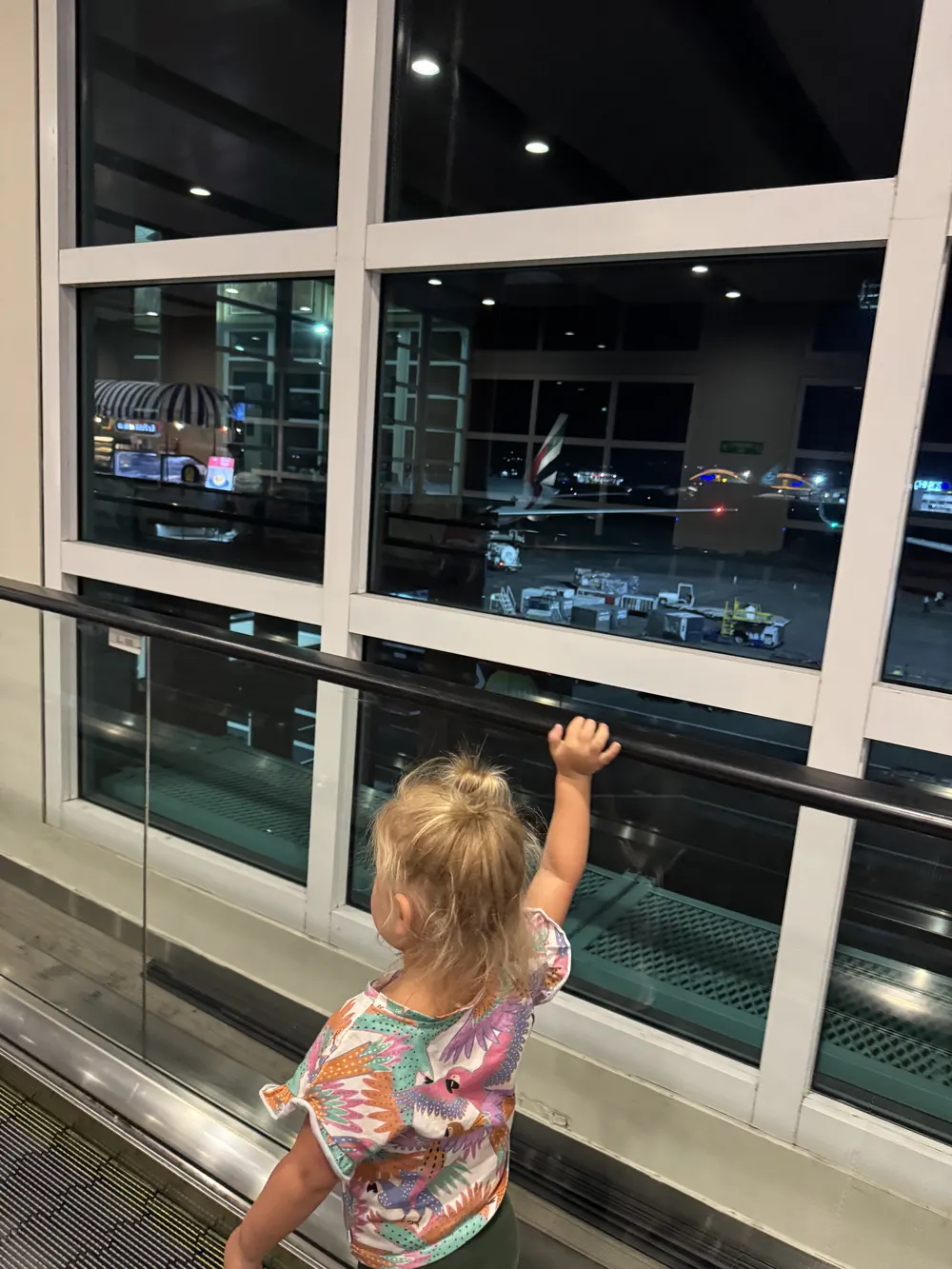
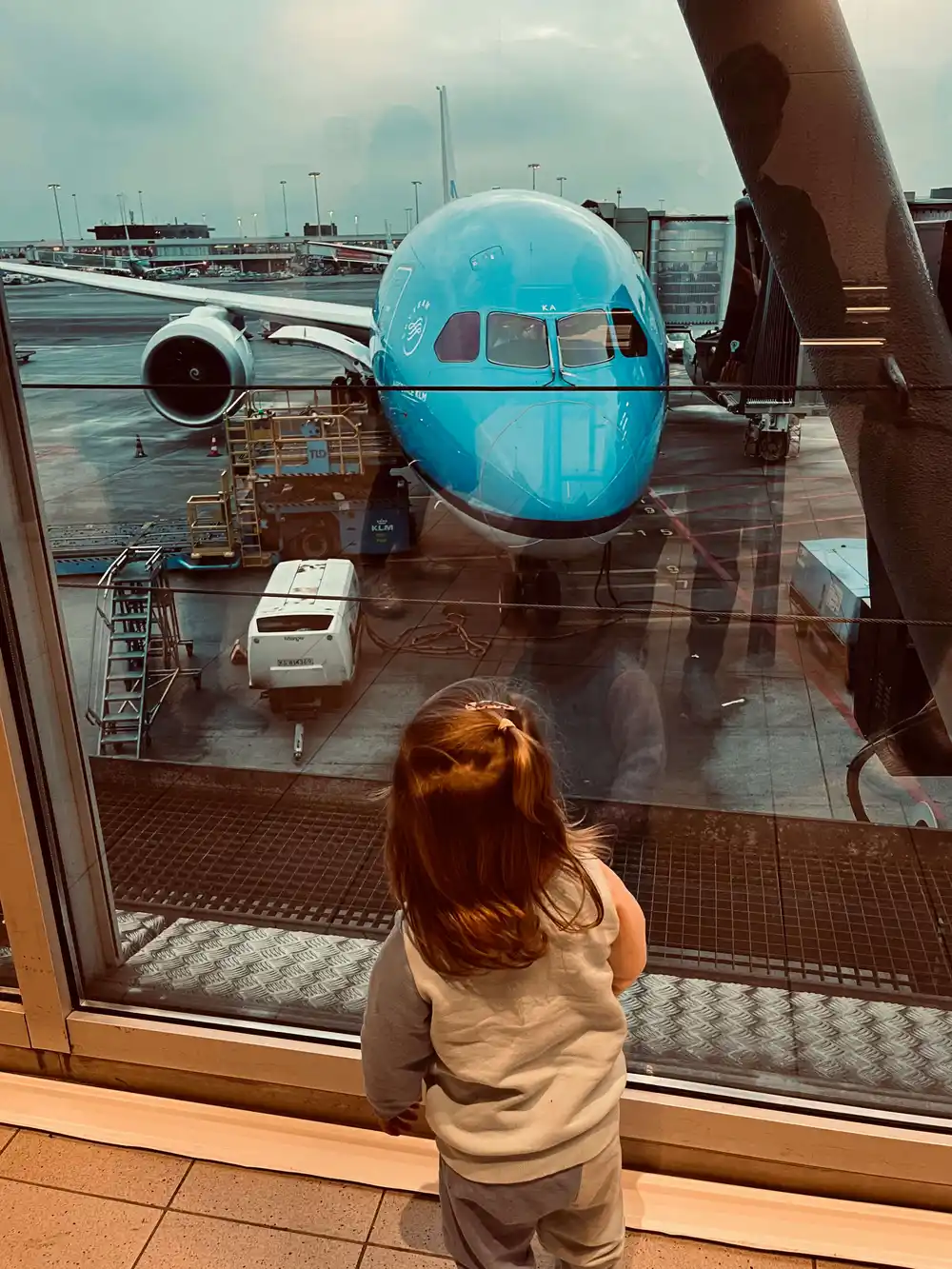
If there is no play area, we still let them walk around a bit, look out the windows, watch the planes, or explore the gate area safely. We’d rather have them use that energy at the airport than save it all for the plane.
Keep One Airport Activity Ready
Waiting at the gate can be harder than expected. Everyone is tired, the space is busy, and toddlers can get restless quickly.
We like to keep one easy activity easy to grab, like stickers, a simple game, a coloring page, or a little airport scavenger hunt. Nothing too big yet, because we still want to save most activities for the flight.
This is also a nice moment to use something from our Travel Activity Book for Kids, because it includes simple travel activities that work well during airport waiting time too. We like having a few screen-free options ready before boarding, instead of trying to invent entertainment when everyone is already tired.
Travel Activity Book for Kids
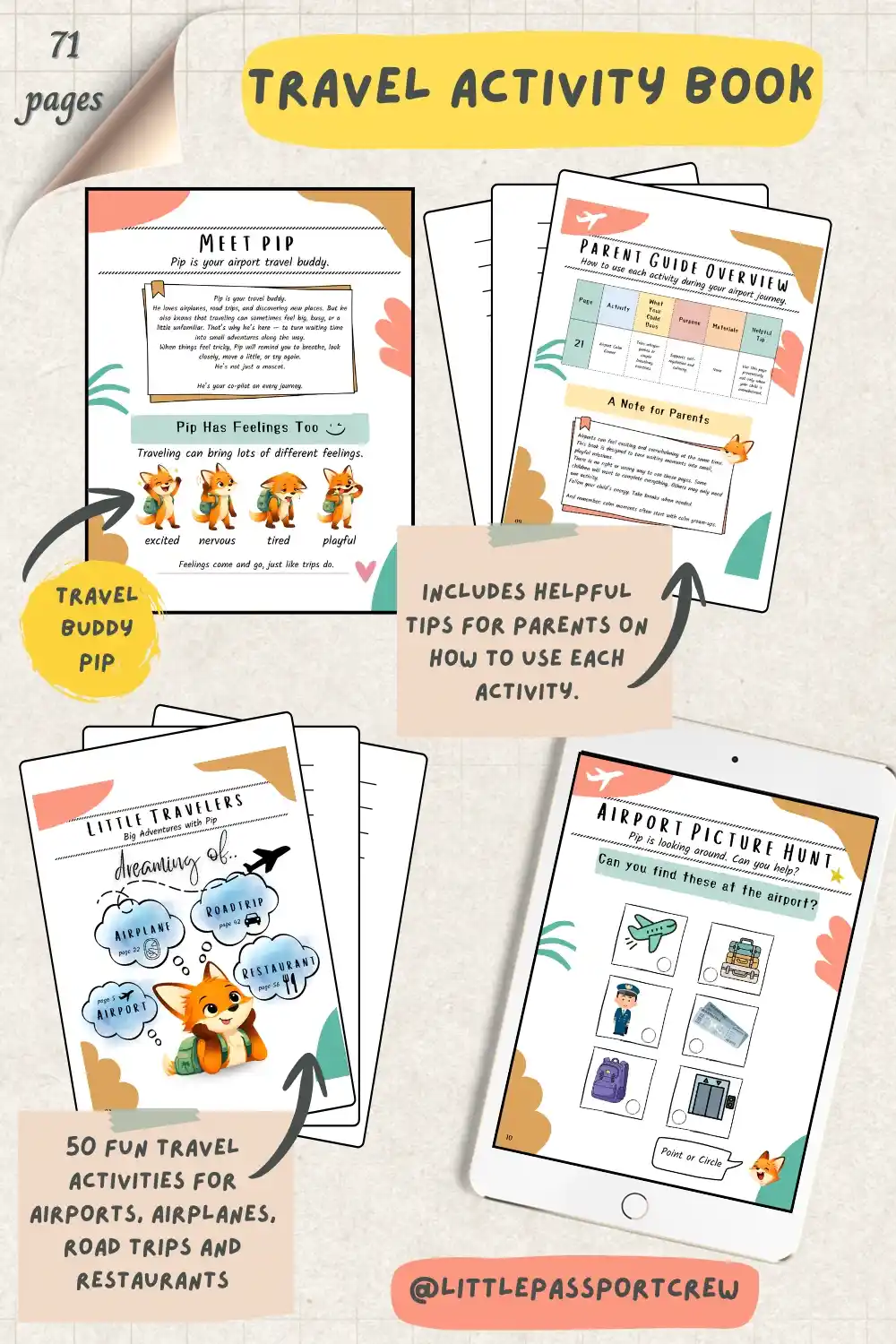
A printable bundle with games, coloring pages and travel activities to keep kids busy during flights, airport waits, road trips, restaurant visits and long travel days.
Board Early and Get Settled
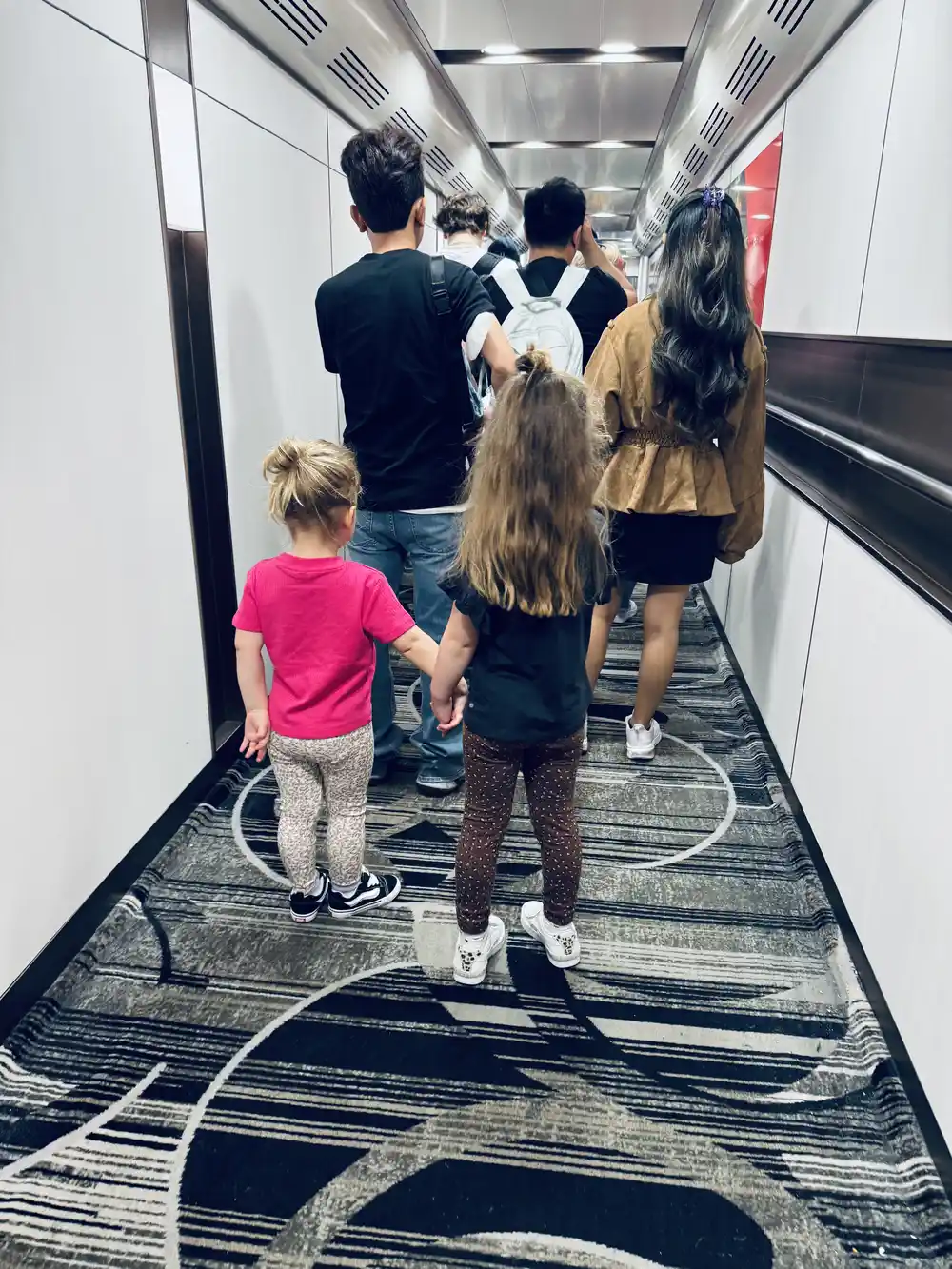
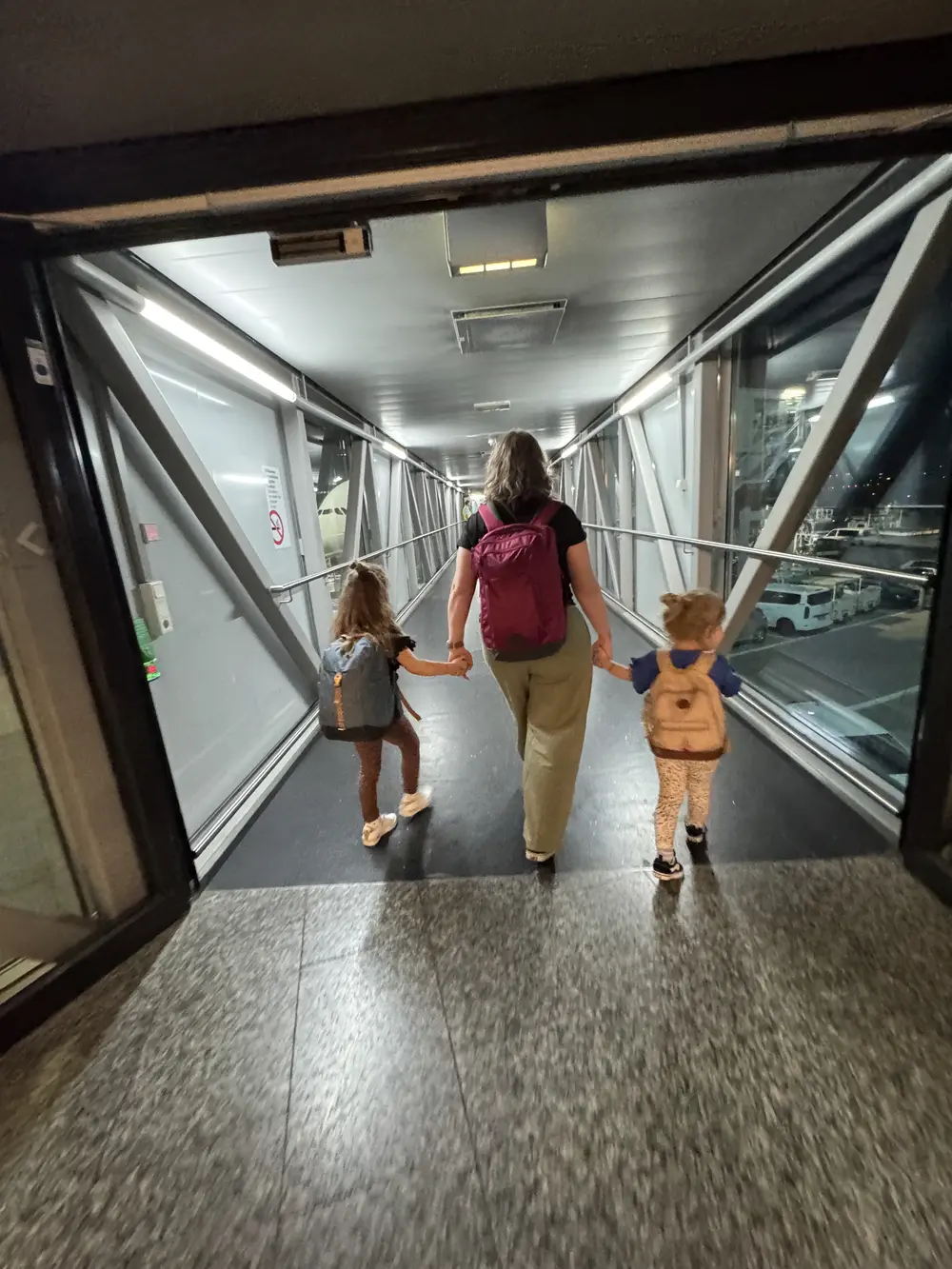
Before kids, we often preferred boarding as late as possible. With young kids, we usually do the opposite.
Most airlines let families with young children board early, and for us, that is usually helpful. You don’t have to wait in a long boarding line, the overhead compartments are still available, and you have a bit more time to get organized.
This is especially useful if you have a stroller, a carrier, kids’ bags, snacks, headphones, tablets, water bottles, and all the other little things that somehow come with flying as a family.
Boarding early gives us time to get settled before the plane feels too crowded.
Bring a Cabin-Size Stroller if You Can
If you’re traveling with a stroller, we personally prefer bringing one that can fit in the airplane cabin. In our experience, this usually works well with compact travel strollers, and we haven’t had problems bringing ours on board so far.
This is why we love traveling with a compact stroller like the Cybex Libelle. It folds down very small and is designed to fit in many overhead compartments, which makes airport travel with tired kids so much easier. A popular alternative is the Stokke YOYO3, which many families also use as a travel stroller.
We would still always check your airline’s cabin baggage rules before you travel, just to avoid surprises. But for us, having a stroller that can come on board has been much easier than gate-checking one and waiting to see where it shows up after landing.
If you do have to gate-check your stroller, that can still be useful because you can use it until boarding. Just keep in mind that you don’t always get it back immediately at the aircraft door when you arrive. Sometimes it comes back at the gate, but sometimes it still ends up at the baggage belt.
That’s one reason we also like having a carrier with us, especially during long travel days, tight transfers, or late-night arrivals. If your toddler is exhausted and you suddenly need to move quickly, having either a cabin-size stroller or a carrier makes airport transfers much easier.
Takeoff and landing are moments where it helps to have a few things ready. Your toddler needs to stay seated, bags may be out of reach, and the seatbelt sign can stay on for a while.
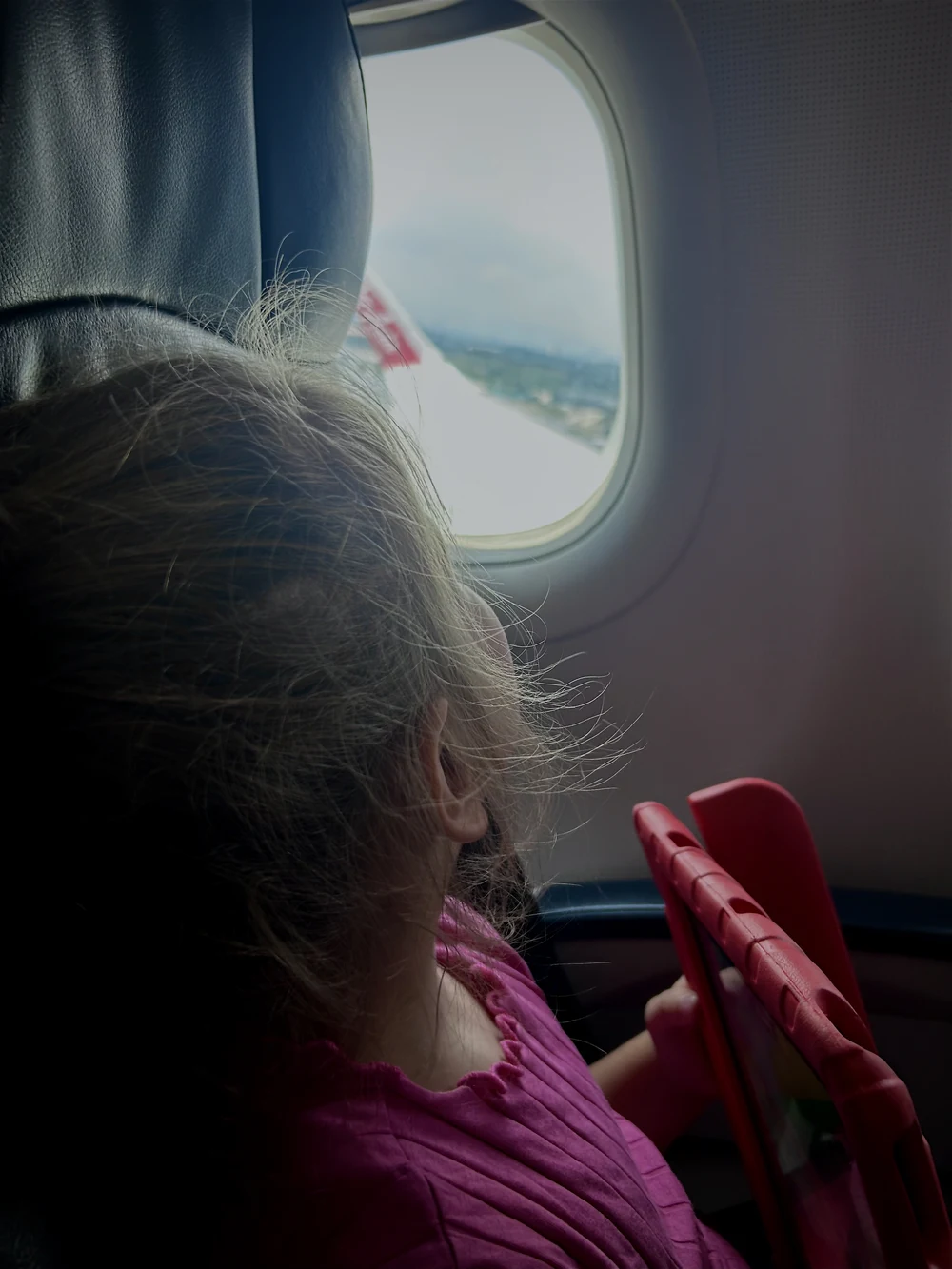
Sometimes kids are completely fine watching out the window, eating a snack, or looking at the iPad. But it’s still useful to be prepared for ear pressure, boredom, or a little frustration.
Quick overview: takeoff and landing with a toddler
- 👂 Help with ear pressure
- 🍼 Offer a drink, snack or pacifier
- 🍿 Keep a few easy snacks close
- 📱 Use screen time if it helps
- 🧸 Keep one small distraction nearby
How to Help Toddler Ears During Takeoff and Landing
One of the main things to think about during takeoff and landing is ear pressure. Some toddlers barely notice it, while others can get uncomfortable.
Drinking, sucking, chewing, or eating something can help during these moments. Depending on your child’s age and habits, that might mean a water bottle, milk, a pacifier, a pouch, a snack, or something chewy.
We usually try to have something ready before the plane starts moving, because once the seatbelt sign is on, you don’t want to be searching through your bag.
For us, the most important thing is having something easy to offer before our toddler gets upset.
What to Give a Toddler During Takeoff and Landing
Takeoff can take longer than you expect. Sometimes you board early, sit for a while, taxi slowly, wait in line, and only then actually take off.
That’s why we like having a few small snacks or drinks ready. Not the whole snack bag, just enough to get through the first part of the flight.
Snacks can help with ear pressure, but they also give toddlers something to do while they have to sit still. On a long haul flight, snacks are part food, part entertainment, and part survival tool.
Is Screen Time Okay During Takeoff and Landing?
We are not strict about screen time on long flights. At home, we have more normal boundaries, but on a long haul flight with toddlers, we see screens as one of the tools that can help everyone get through the journey.
For takeoff or landing, a familiar show can be especially useful because your toddler has to stay seated. If it helps them stay calm, we’re fine with that.
Keeping a toddler entertained is one of the most challenging parts of flying with a toddler on a long haul flight. We’ve learned that it works better to spread things out and keep a few options for later.
So instead of giving everything at once, we move through the flight in small moments: a snack, a small activity, a walk through the aisle, a show on the iPad, some stickers, another snack, maybe a bit of sleep, maybe no sleep at all.
Quick overview: toddler airplane activities
- 🎨 Rotate activities slowly
- 🍿 Use snacks as little breaks
- 🧸 Bring a few small surprises
- 📱 Download shows and games beforehand
- 🎧 Bring toddler headphones
- ✏️ Choose simple, low-mess activities
- 📖 Use a travel activity book
- 🚶 Let your toddler move around when possible
Rotate Toddler Airplane Activities Slowly
One thing that helps a lot is not giving everything at once. Toddlers can go through toys, snacks, and activities very quickly if they see the whole bag.
So we try to rotate things slowly. One activity, then a snack. A little walk, then a show. Stickers, then a coloring page. Another snack, then maybe a small surprise.
Breaking the flight into smaller parts makes it feel much less overwhelming for us. Instead of trying to entertain your toddler for ten hours, you’re just getting through the next small part.
We also like bringing a separate bag with a few little “surprises” inside. Not big toys, and not too many. Just small things they can unwrap every now and then, or when the flight gets a little harder. It could be stickers, a tiny toy, a coloring page, a small book, or something they haven’t seen before.
The surprise and unpacking is often half the fun, so we don’t show the whole bag at once.
Best Toddler Airplane Activities That Worked for Us
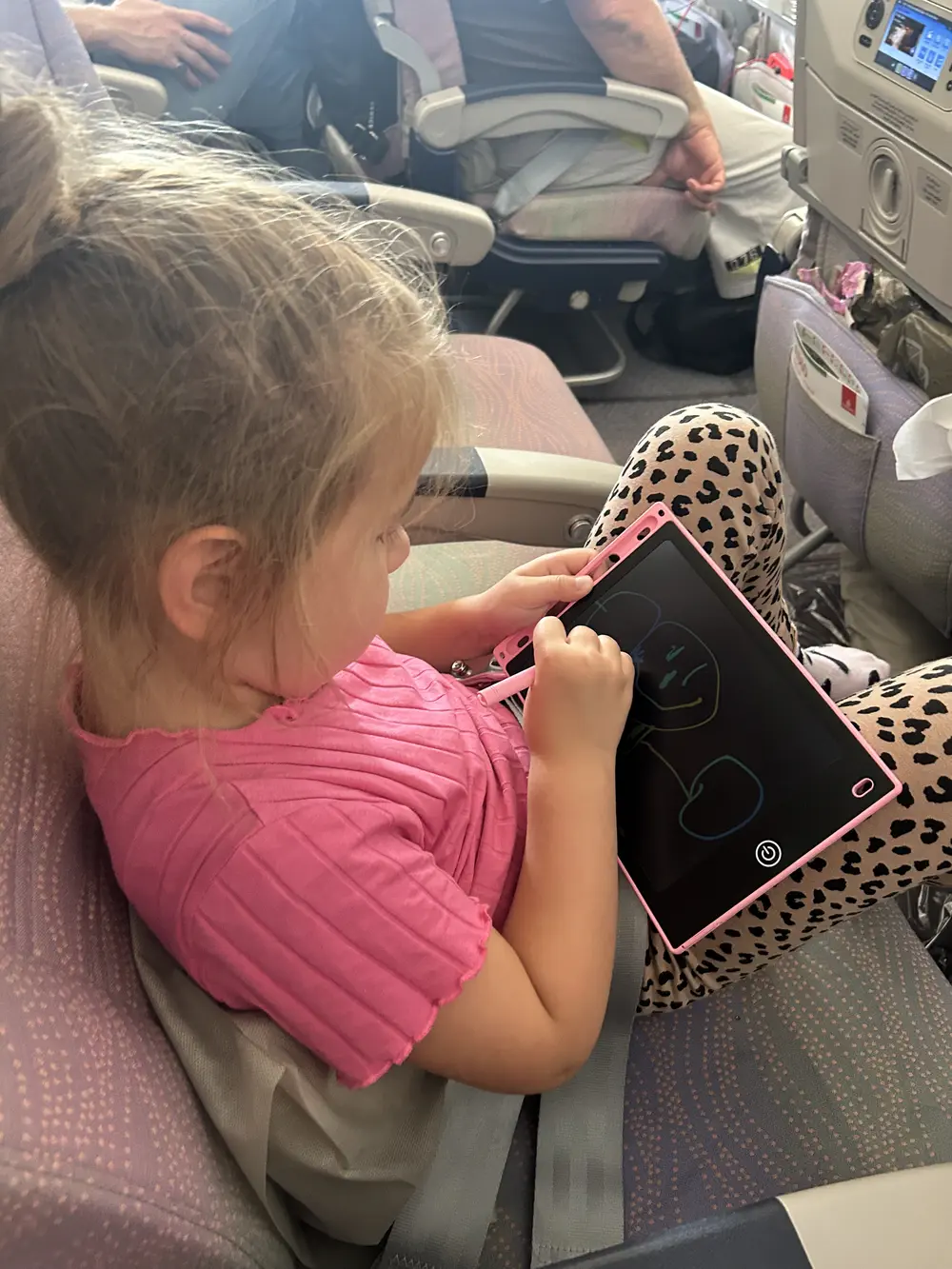
The best airplane activities for toddlers are usually simple, quiet, and not too messy. We don’t want tiny pieces everywhere, loud toys, or anything that needs too much help from us every two minutes.
Things that have worked well for us:
- Stickers
- Small coloring books
- A small LCD drawing board
- Simple travel games
- A few surprise toys (like magnetic tiles)
- Books
- Snacks in small portions
- iPad with downloaded shows
- Toddler headphones
We usually avoid bringing too many toys. A few small, well-timed surprises work better for us than a bag full of random things. Too much choice can make the bag messy and the flight feel more chaotic.
If you want a bigger list, we also have a full guide with 25 plane activities for kids.
Use Screen Time on Long Flights Without Making It the Whole Plan
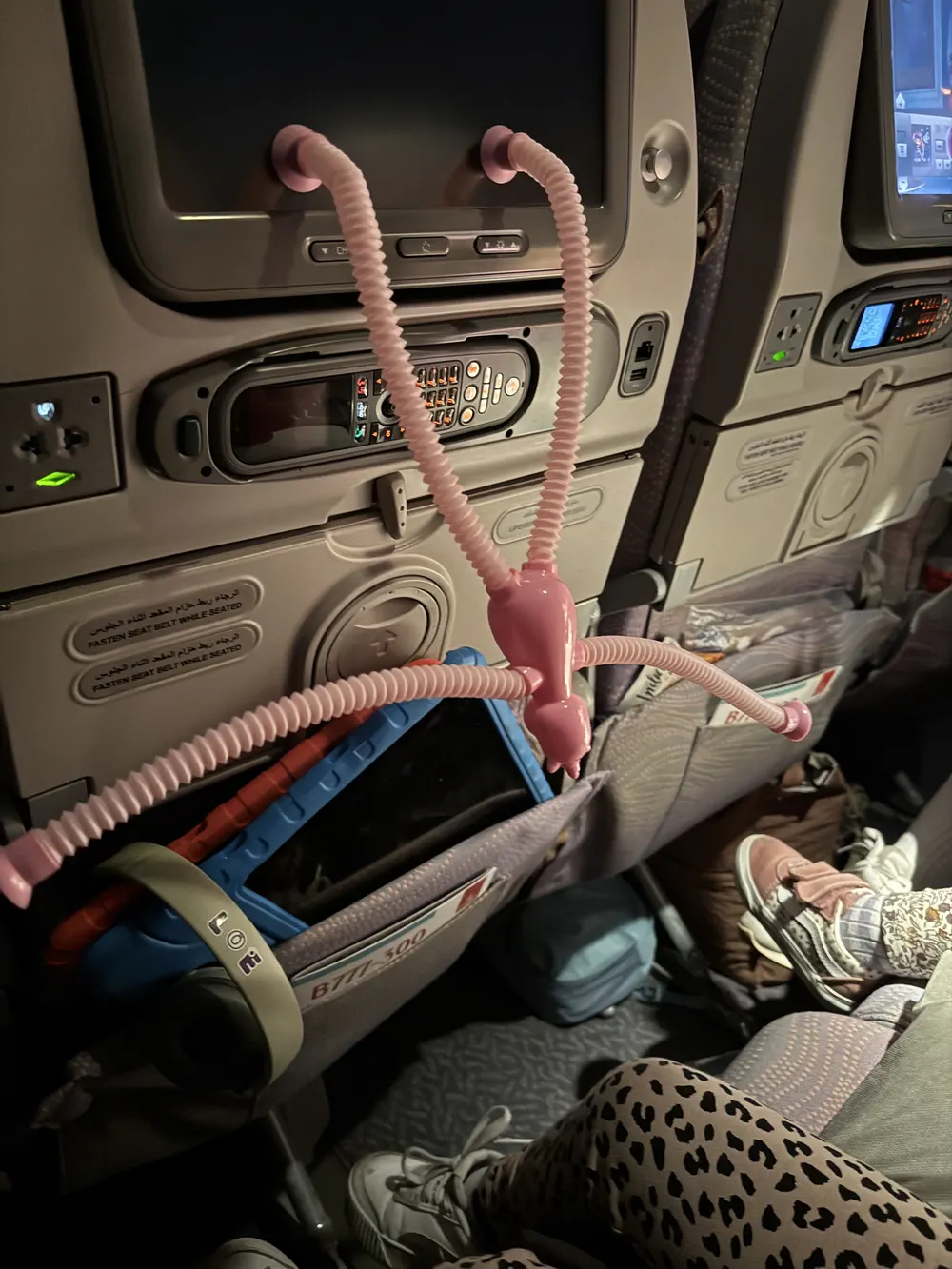
We are very relaxed about screen time on long flights. At home, we have more normal boundaries, but on a long haul flight with toddlers, the iPad can be incredibly helpful.
We download shows, games, and sometimes music before we leave. We also make sure the headphones work and that the kids are used to wearing them. That part is worth testing at home, because the plane is not the best place to discover that your toddler refuses headphones.
For us, the iPad is not the whole plan, but it is definitely part of the plan.
Try Screen-Free Travel Activities
Even though we use screens, we also like having screen-free activities ready. They are useful when the kids need a break from the iPad, when the battery is low, during waiting time at the airport, or when we just want a calmer activity.
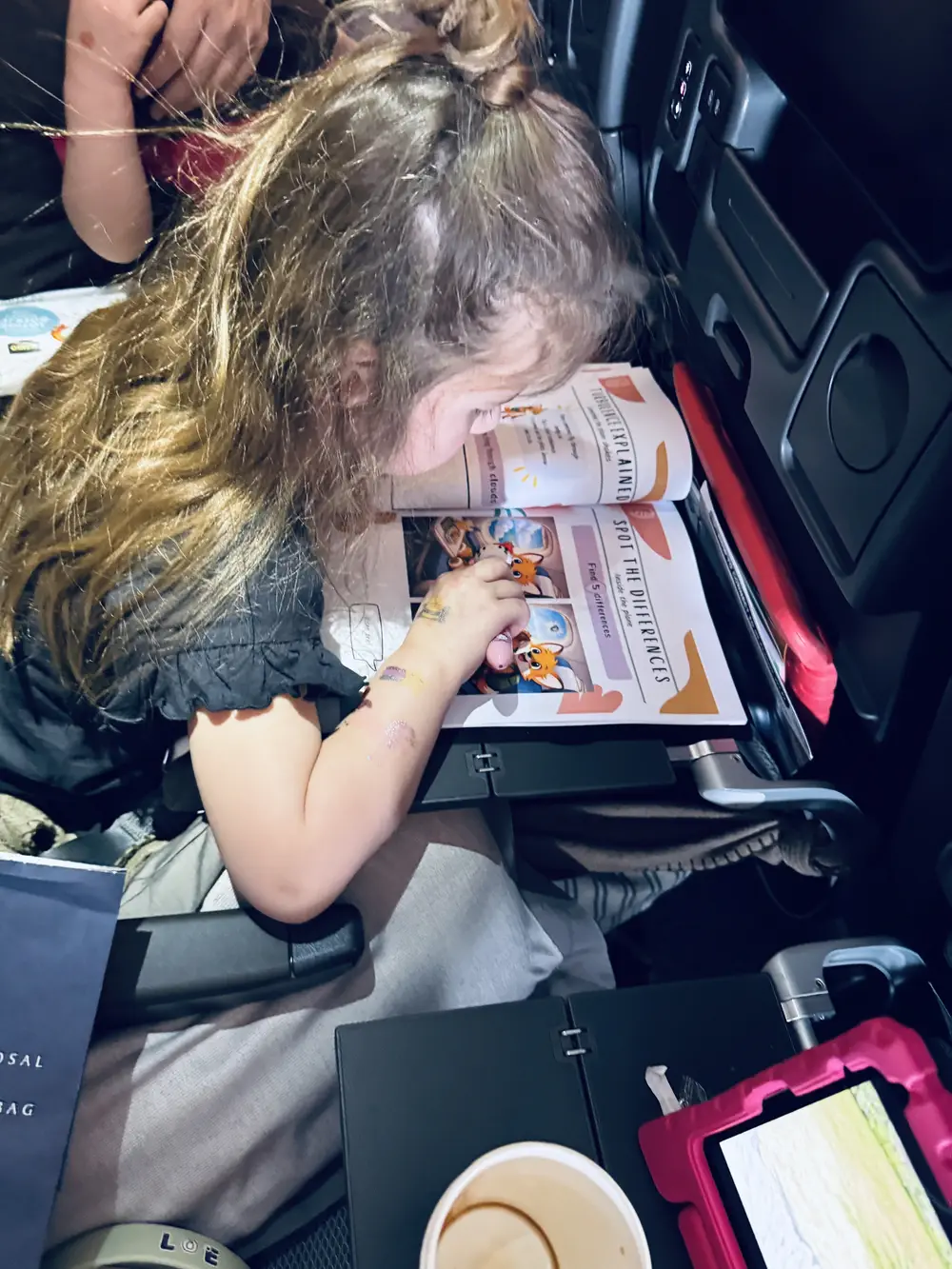
This is exactly why we created our Travel Activity Book for Kids. It includes printable games, coloring pages, travel-themed activities, and simple screen-free ideas for flights, airport waits, and long travel days.
We like that it gives kids something to do without needing Wi-Fi, batteries, or another app. You can print the pages before your trip and bring only the ones that fit your child’s age and interests.
Travel Activity Book for Kids
A printable bundle with games, coloring pages and travel activities to keep kids busy during flights, airport waits, road trips, restaurant visits and long travel days.
Want More Ideas? Read Our 25 Plane Activities for Kids
This section gives you the main idea of what worked for us, but we don’t want to turn this whole guide into one giant activity list.
If you want more specific ideas, check out our full guide with 25 plane activities for kids. It includes more screen-free ideas, simple toys, and easy activities you can bring on your next flight.
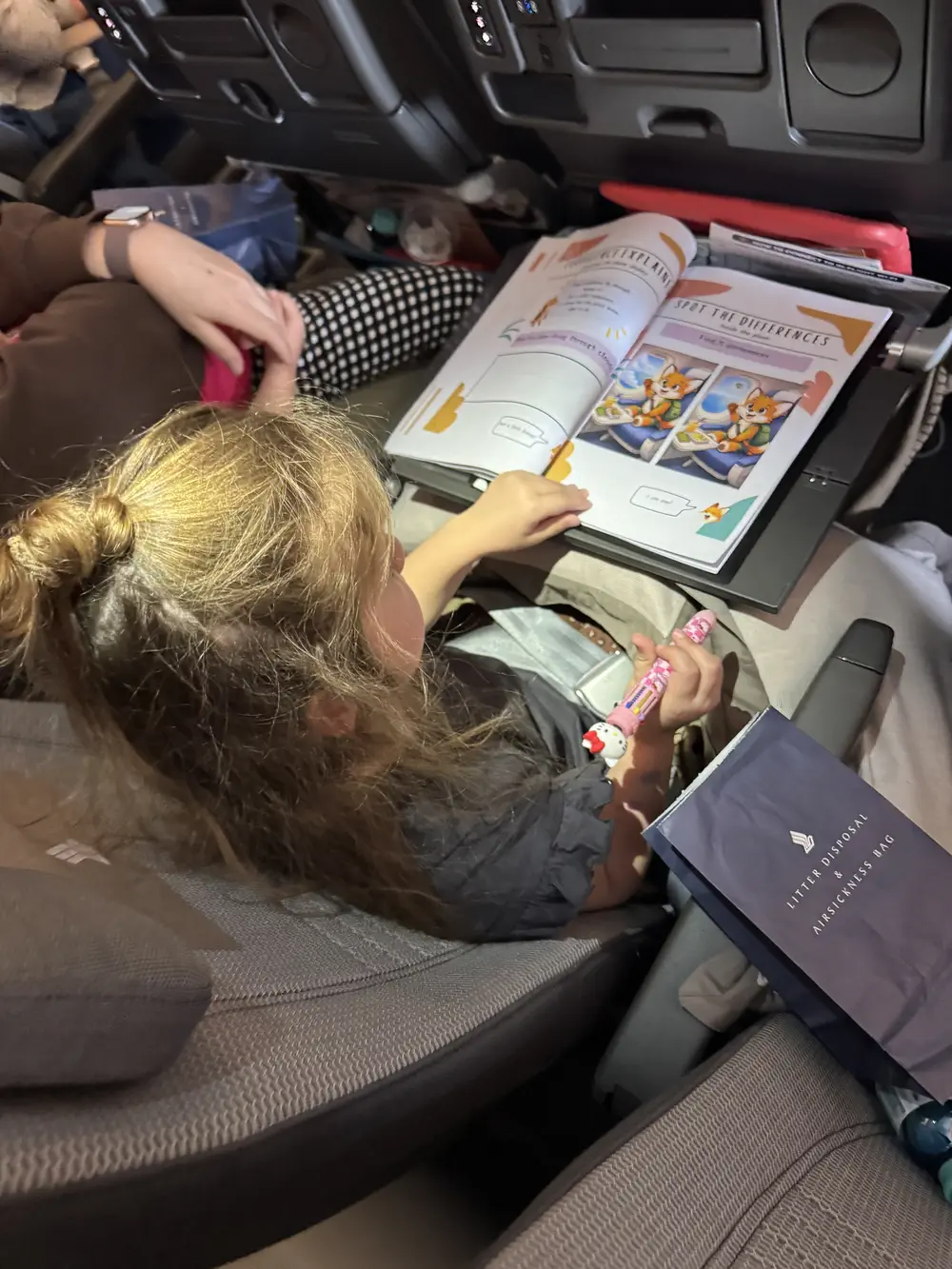
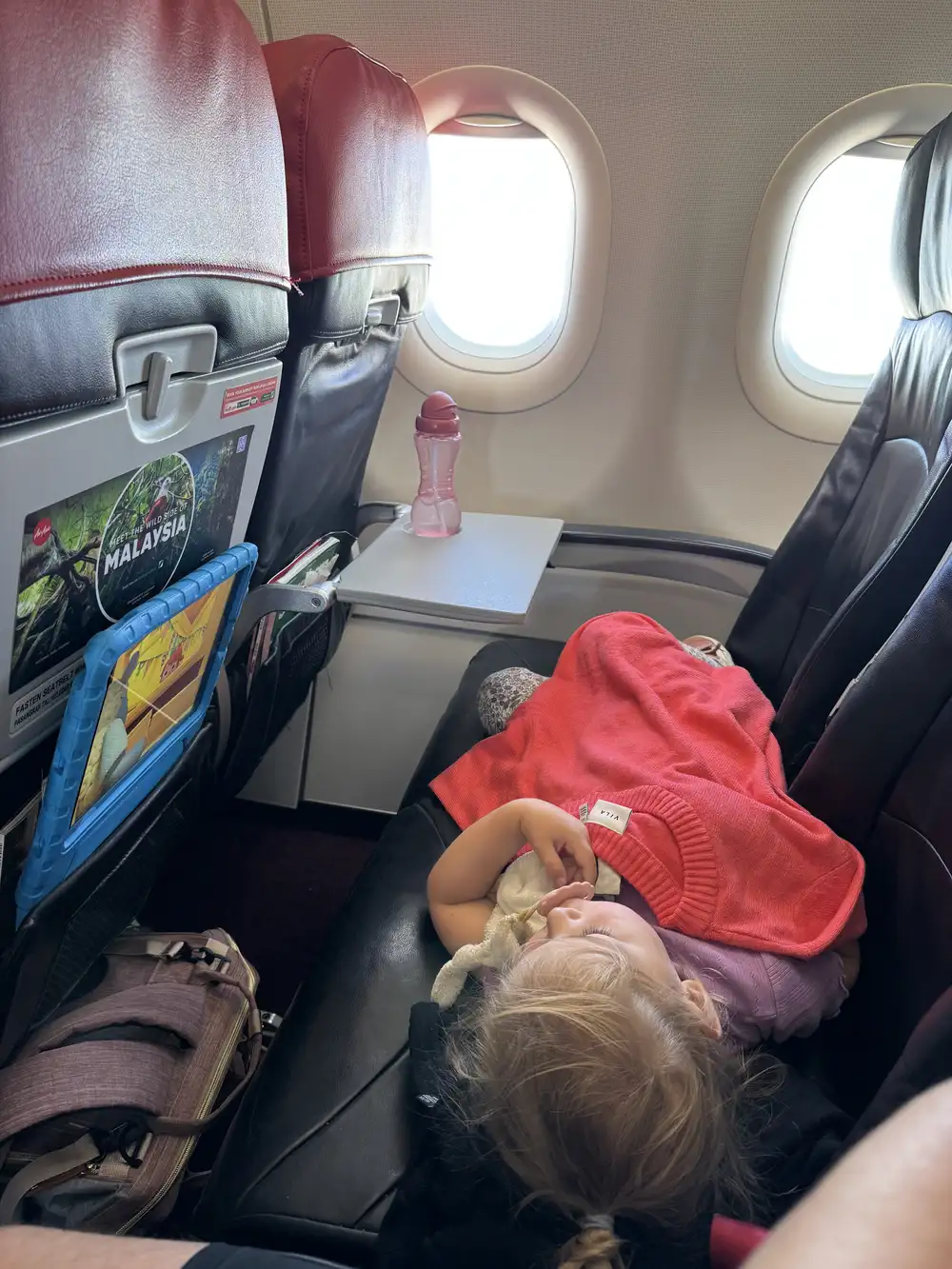
Sleep is one of the hardest things to predict when flying with a toddler. You can prepare for it, but you can’t fully control it. We’ve had flights where the kids slept surprisingly well, and flights where sleep barely happened at all.
For us, one lesson has been to stop forcing it. We try to make things comfortable, keep the mood calm, and let them wind down in their own way. Sometimes we read a book. Other times, the kids watch the iPad a little longer than planned or play quietly until they are finally tired enough to sleep.
Quick overview: toddler sleep on a plane
- 😴 Keep your expectations realistic
- 🛏️ Make the seat as comfortable as possible
- 🧸 Bring a favorite stuffed animal
- 📖 Read or do something calm before sleep
- 📱 Use the iPad if it helps them relax
- 🚶 Walk around if they are too restless
- 💤 Don’t force sleep too much
Will a Toddler Sleep on a Plane?
Some toddlers sleep quite well on planes, especially during overnight flights. Others fight sleep because everything is new, exciting, uncomfortable, or just different from home.
We’ve learned not to build the whole flight around sleep. Of course, we hope they sleep. And yes, even a few hours can make a long haul flight feel much easier. But if we expect a perfect night of sleep, we usually end up more frustrated.
So we prepare for sleep, but we also prepare for no sleep. That mindset alone makes flying with a toddler feel less stressful.
💡 Crew Tip: we do notice that flying gets easier the more often you do it. So maybe the best solution is simply to travel more often. Purely for practice, of course.
How to Make a Plane Seat More Comfortable for Toddler Sleep
A plane seat is not exactly a toddler bed, but there are a few things that can make it more comfortable.
For us, an inflatable airplane bed or footrest has worked really well on long haul flights. It gives kids a bit more space to stretch out, rest their legs, or curl up more comfortably. Just make sure to check your airline’s rules before bringing one, because not every airline allows them.
We also dress the kids in comfy clothes from the start, so we don’t have to change them into pajamas on the plane. A favorite stuffed animal can help too, especially if it’s part of their normal sleep routine.
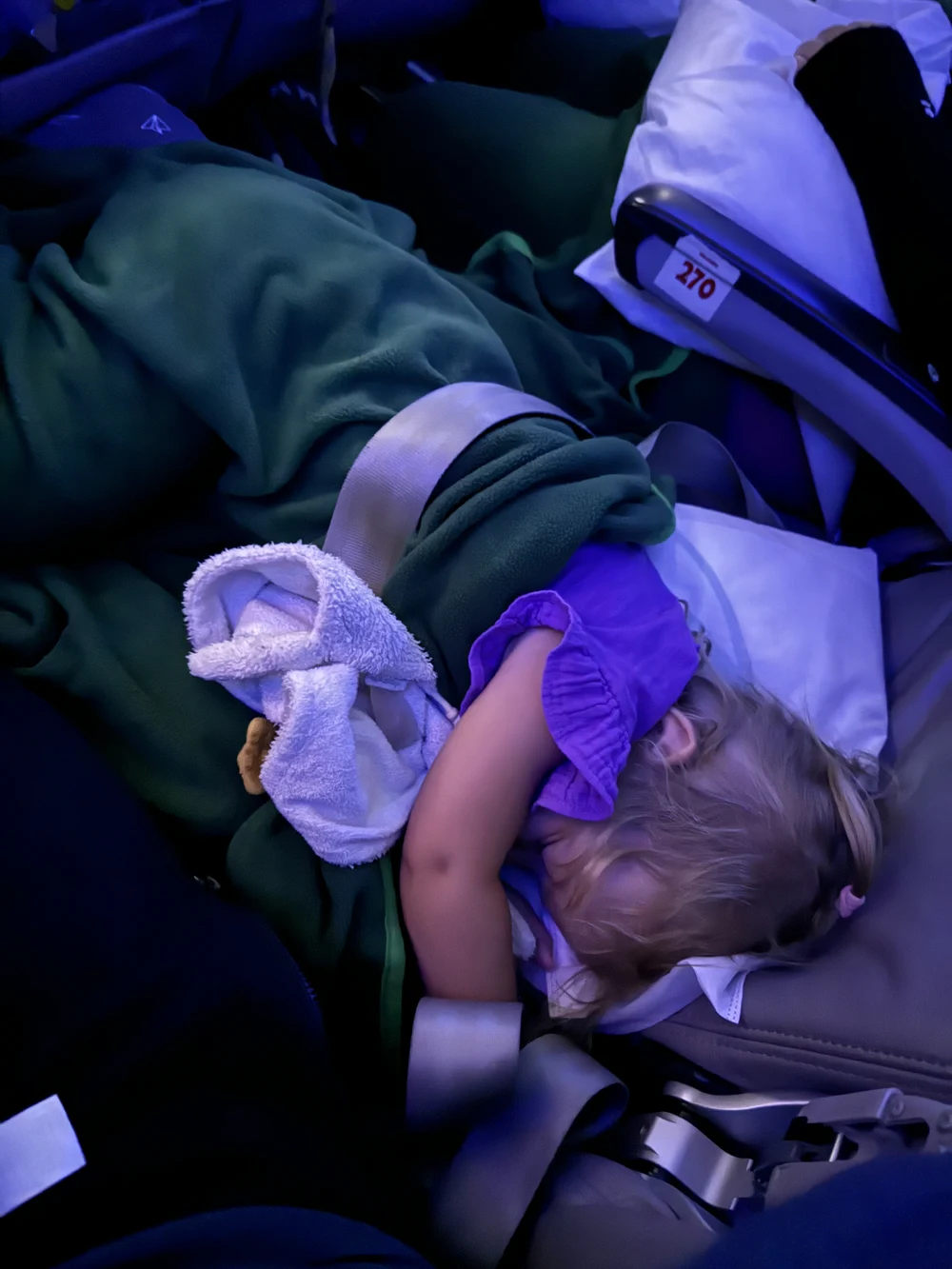
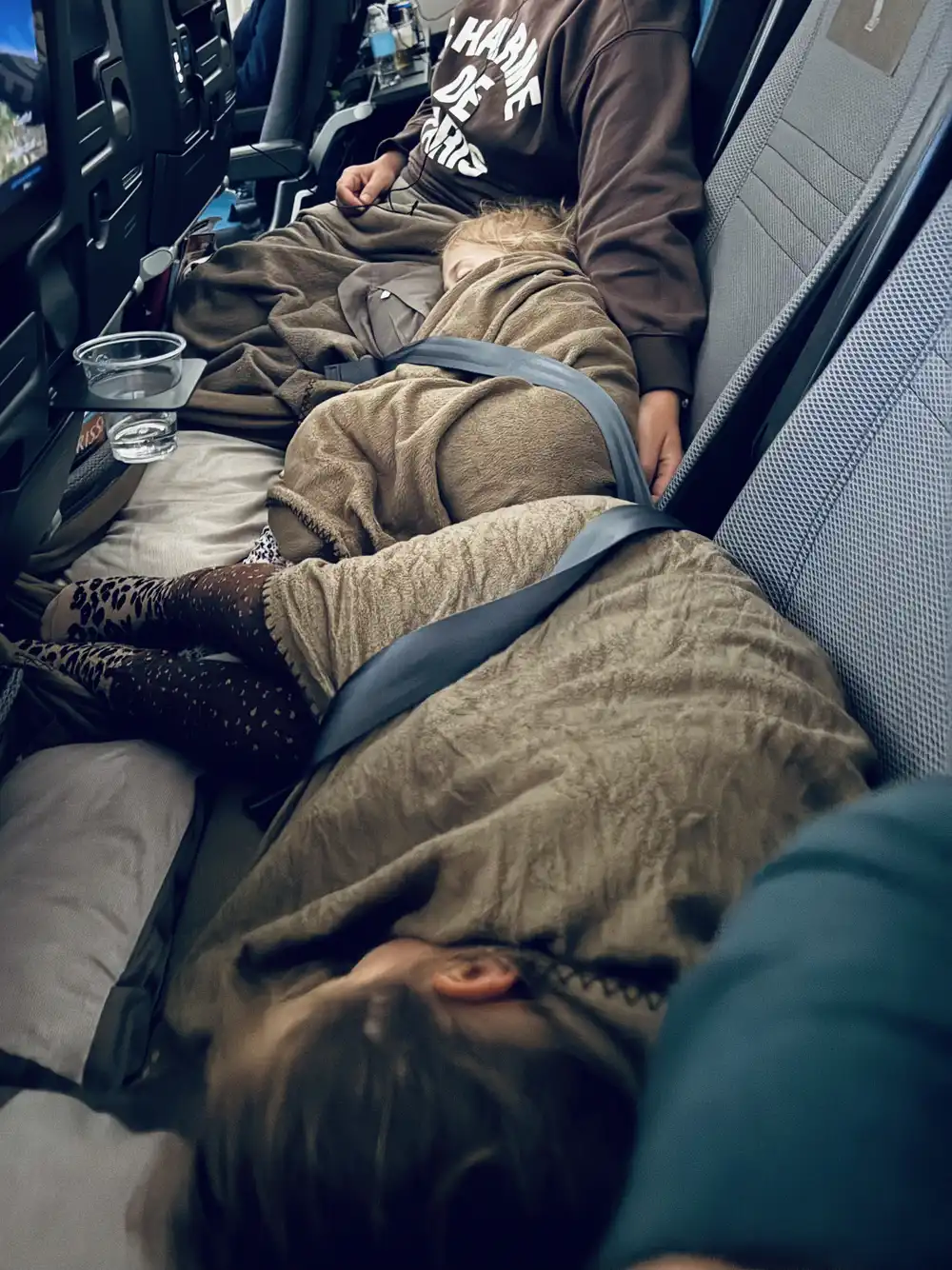
Stop Trying to Control Toddler Sleep Too Much
This is probably the biggest change in how we fly now compared to our first long flights with kids.
At first, we tried much harder to get them to sleep at the “right” time. But the more pressure we put on sleep, the more stressful it felt for everyone.
Now we usually let them wind down more naturally. We might read a book, play quietly, cuddle, or let them watch something calm on the iPad. If they are not tired yet, we don’t keep pushing.
For us, quiet time often works better than forced sleep. Most of the time, they eventually fall asleep anyway. And if they don’t, at least the mood stays calmer.
What If Your Toddler Won’t Sleep on the Plane?
If your toddler won’t sleep, we usually stop trying for a while. The harder we pushed for sleep, the more frustrated everyone became.
Instead, we go back to the basics: a snack, an activity, a bit of movement if possible, or a familiar show on the iPad. After a while, we might try again with a book, a cuddle, or just some quiet time.
It’s not ideal when sleep doesn’t happen, especially on a long haul flight. But for us, it works better to keep the flight moving than to spend hours trying to chase a nap that clearly isn’t happening.
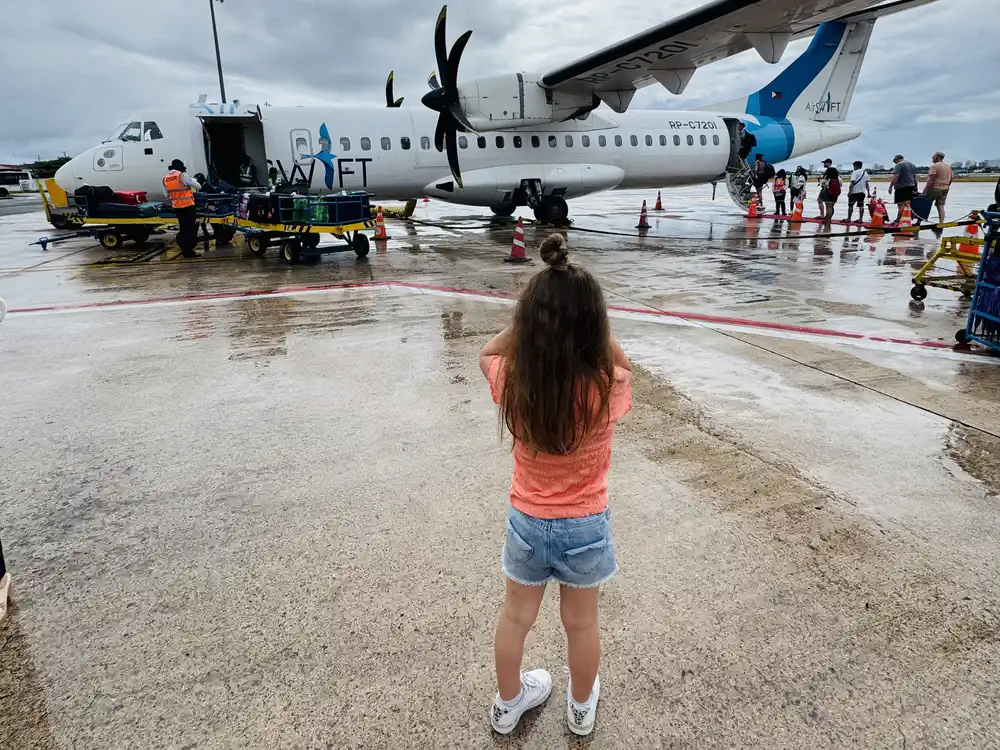
After several long haul flights with our kids, we’ve learned that flying with a toddler is not about one perfect trick. For us, it’s usually a few practical things that make the flight easier.
Some things sound very basic, but they are usually the things that help us most during long flights: enough food, spare clothes, plastic bags, walking breaks, a calm mindset, and accepting that the flight might not be restful for anyone.
Quick overview: what helped us most
- 🍿 Bring more food than you think you need
- 👕 Pack spare clothes for your toddler and yourself
- 🛍️ Bring plastic bags for dirty clothes or accidents
- 😴 Prepare yourself for very little sleep
- 🚶 Use walks through the aisle when possible
- ❤️ Stay calm, even when things get messy
- 🙈 Try not to worry too much about other passengers
Airplane Food with Toddlers: Don’t Rely on It Too Much
Airplane food can be very hit or miss with toddlers. One of our daughters really does not like airplane meals. And by “does not like,” we mean she can look at the tray like someone has personally offended her.
The funny thing is: at home, she is actually quite an easy eater. But on a plane, with different smells, strange timing, tiredness, and excitement, food can suddenly become a whole thing.
So we don’t rely too much on airplane food anymore. If the kids eat it, great. If they don’t, we’re not stuck. We bring familiar food and snacks ourselves, and we try to eat something before boarding if we have time.
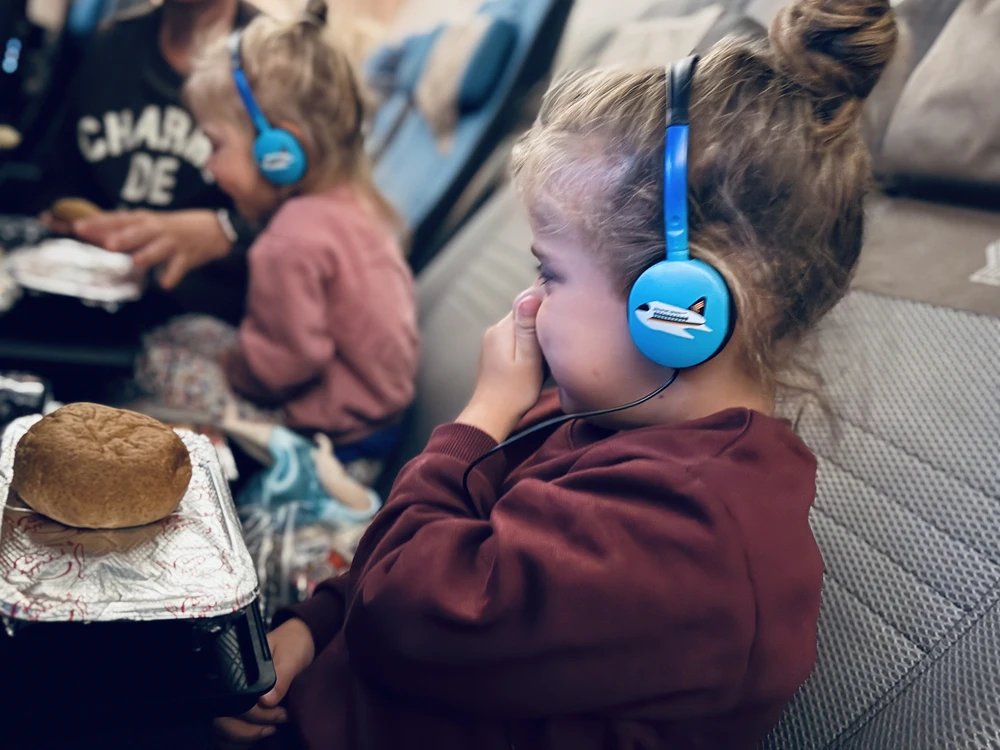
Pack Spare Clothes for Your Toddler and Yourself
This is one of those things you hope you won’t need, but you’ll be very happy to have if you do. And don’t forget plastic bags.
On our last trip to the Philippines, one of our daughters got sick on the plane and threw up during the flight. Not the glamorous side of family travel, but very real.
In that moment, we were really glad we had spare clothes, wipes, and plastic bags in our carry-on. We could change her, put the dirty clothes away, and deal with the situation without completely panicking.
So yes, pack spare clothes for your toddler. But also consider packing at least one spare shirt for yourself. If your child gets sick, spills a drink, has an accident, or falls asleep on you after a messy snack situation, you might need it too.
Plastic bags take almost no space, but they are one of the most useful things in your carry-on when flying with kids.
Prepare Yourself for a Tiring Flight
This sounds negative, but for us it actually helps: we don’t board a long haul flight expecting a relaxing night.
If the kids sleep, amazing. If we get some sleep too, even better. But we prepare ourselves for the possibility that the flight will be broken, messy, and tiring.
The flight usually feels easier once we stop expecting everything to go smoothly. Instead of getting frustrated every time someone wakes up, needs a snack, wants to move, or refuses to sleep, we just try to handle one moment at a time.
💡 Crew Tip: if you’re traveling with two adults, try to make sure at least one of you gets some sleep, even if the kids don’t sleep much. Even one hour can make the rest of the flight, arrival, or first day feel a little easier.
Stay Calm When Things Get Messy
This might be the hardest part, especially during your first long flights with kids.
If your toddler cries, refuses to sleep, spills something, or has a difficult moment, it’s easy to start worrying about everyone around you. We’ve definitely felt that pressure too.
But in our experience, most people are either kind, understanding, or simply focused on their own flight. And sometimes, even when you prepare well, toddlers are still toddlers.
Of course, we try to be considerate. We don’t let the kids kick seats, throw things, or disturb people on purpose. But toddlers are toddlers. Sometimes they cry, get tired, or simply reach the point where they’ve had enough of the flight.
We just try to stay calm, solve the next thing, and not turn one messy moment into the whole flight.
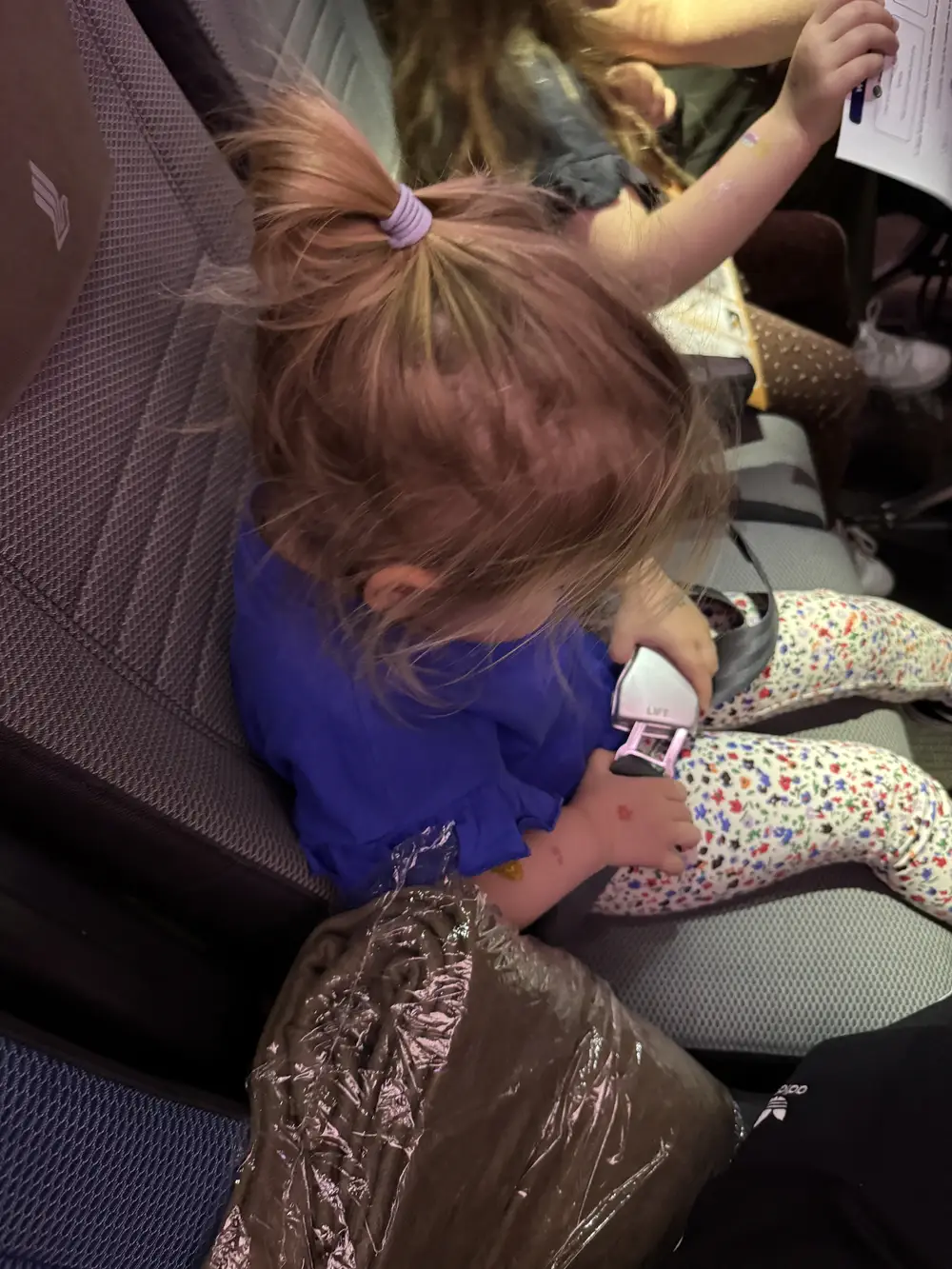
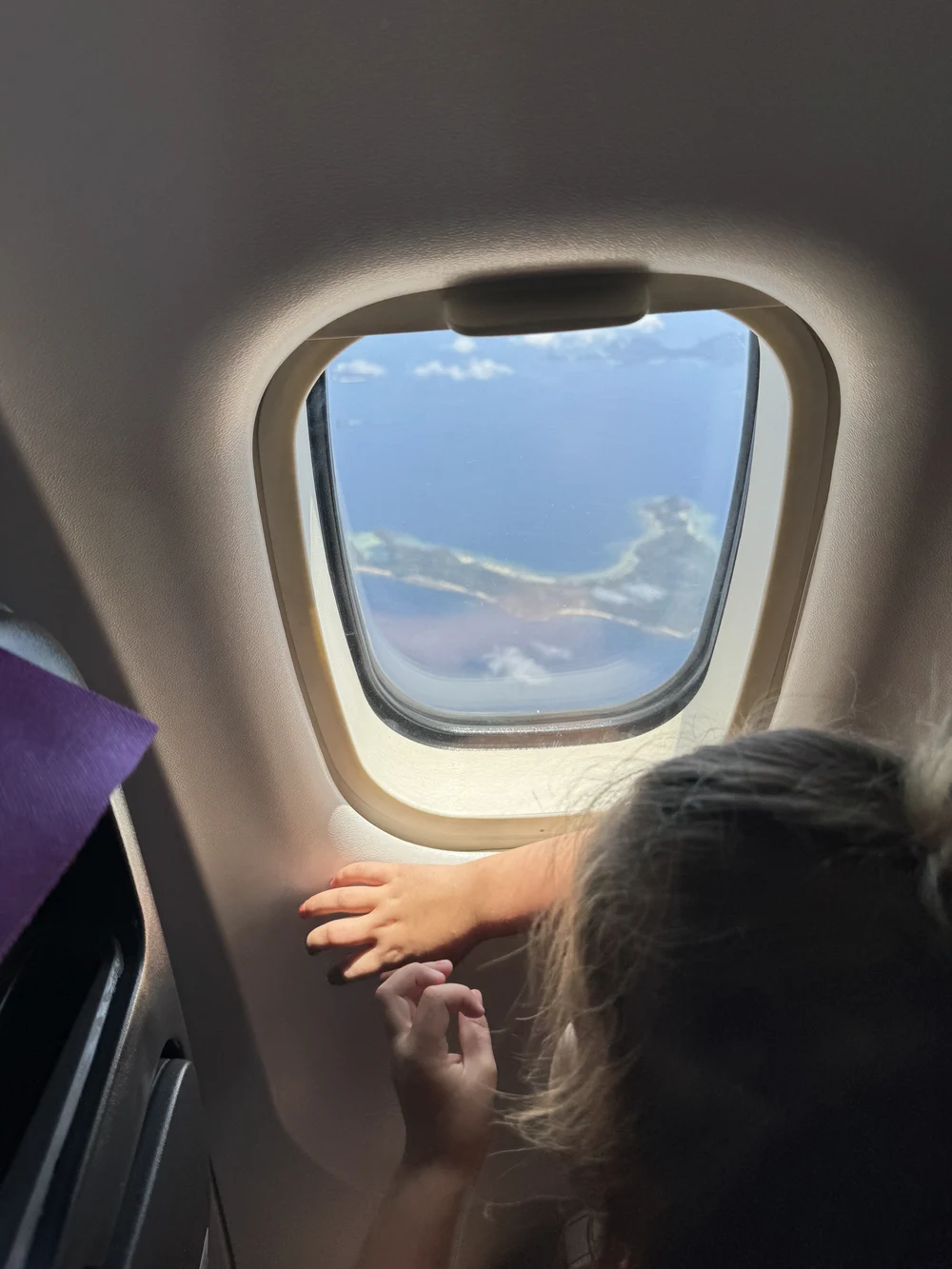
After a long haul flight with a toddler, landing can feel like the finish line, but you’re not quite there yet. You still have to get off the plane, find your stroller or carrier, go through immigration, collect your bags, and get everyone to your accommodation.
On many of our long haul trips to Asia, we arrived later in the day or in the evening. At that point, we don’t try to do much anymore. We usually focus on the basics: food, showers, getting the room sorted, and helping everyone move toward the local rhythm.
Quick overview: after the flight
- 🛬 Wake sleeping kids before the last minute
- 🎒 Keep passports and essentials easy to reach
- 🚿 Keep the first evening simple
- 🍽️ Offer food, but don’t worry if appetite is off
- ⏰ Try to move toward the local rhythm
- 😴 Don’t let everyone sleep too late the next morning
Landing with a Toddler: Wake Them Before the Last Minute
Landing is usually similar to takeoff: something to drink, a small snack, a familiar show, or something calm to do can help your toddler stay seated.
One thing we try to do now is wake the kids a little before we actually have to get off the plane. If they are still sleeping when everyone suddenly stands up, opens overhead bins, and starts moving, they can wake up confused, grumpy, or still half asleep.
And honestly, carrying bags, finding passports, and getting out of the plane is already enough. A deeply sleeping toddler who suddenly has to walk is not always ideal.
So if they are asleep near the end of the flight, we usually give them a bit of time to wake up slowly before landing or before everyone starts leaving the plane.
Don’t Overplan the First Day After Arrival
After a long flight, we try not to plan too much for the first day. Even if everyone is excited, kids often need time to land, eat, shower, and adjust.
If the kids slept a lot on the plane, we usually don’t put them straight to bed as soon as we arrive, unless it’s really late. We first focus on the basics: eat a little, take a shower, unpack what we need, and then go to bed at a time that makes sense locally.
If they barely slept, we still try to keep the first day calm. A short walk, some daylight, an easy meal, and an early night can be enough.
Jet Lag with Toddlers: Start Moving Toward the Local Rhythm
Jet lag with toddlers can be unpredictable, so we try not to make it too complicated. We usually aim to move toward the local rhythm as soon as possible, without expecting everything to be perfect on day one.
If you arrive late, it can be tempting to let everyone sleep in for hours the next morning. Sometimes you need a little extra rest, of course. But if you want to adjust faster, it usually helps to set an alarm, get up around a normal local time, have breakfast, and get some daylight.
Your child’s appetite may also be strange for a few days. They might be hungry at odd times or not very interested in meals. In our experience, this usually settles once their body clock starts to adjust.
We’ll probably write a separate guide about jet lag with kids later, but for this blog, our main advice is simple: keep the first day calm, get daylight, eat when you can, and gently move toward the local rhythm.
If you are flying into Malaysia with a toddler, it can help to plan a gentle first stop before moving on. Our Kuala Lumpur itinerary with kids includes easy 1, 2, 3 and 4-day routes that work well after a long flight.
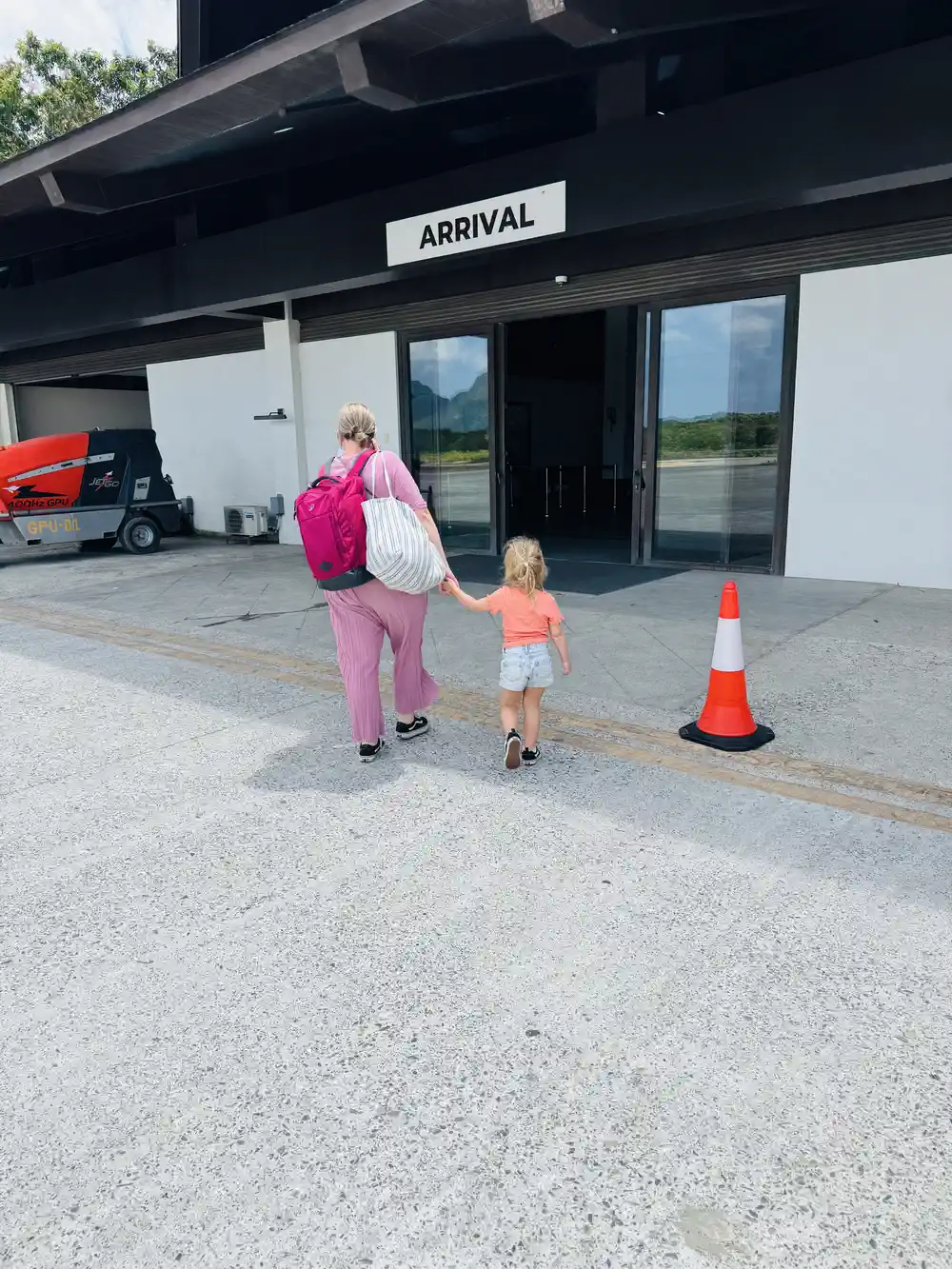
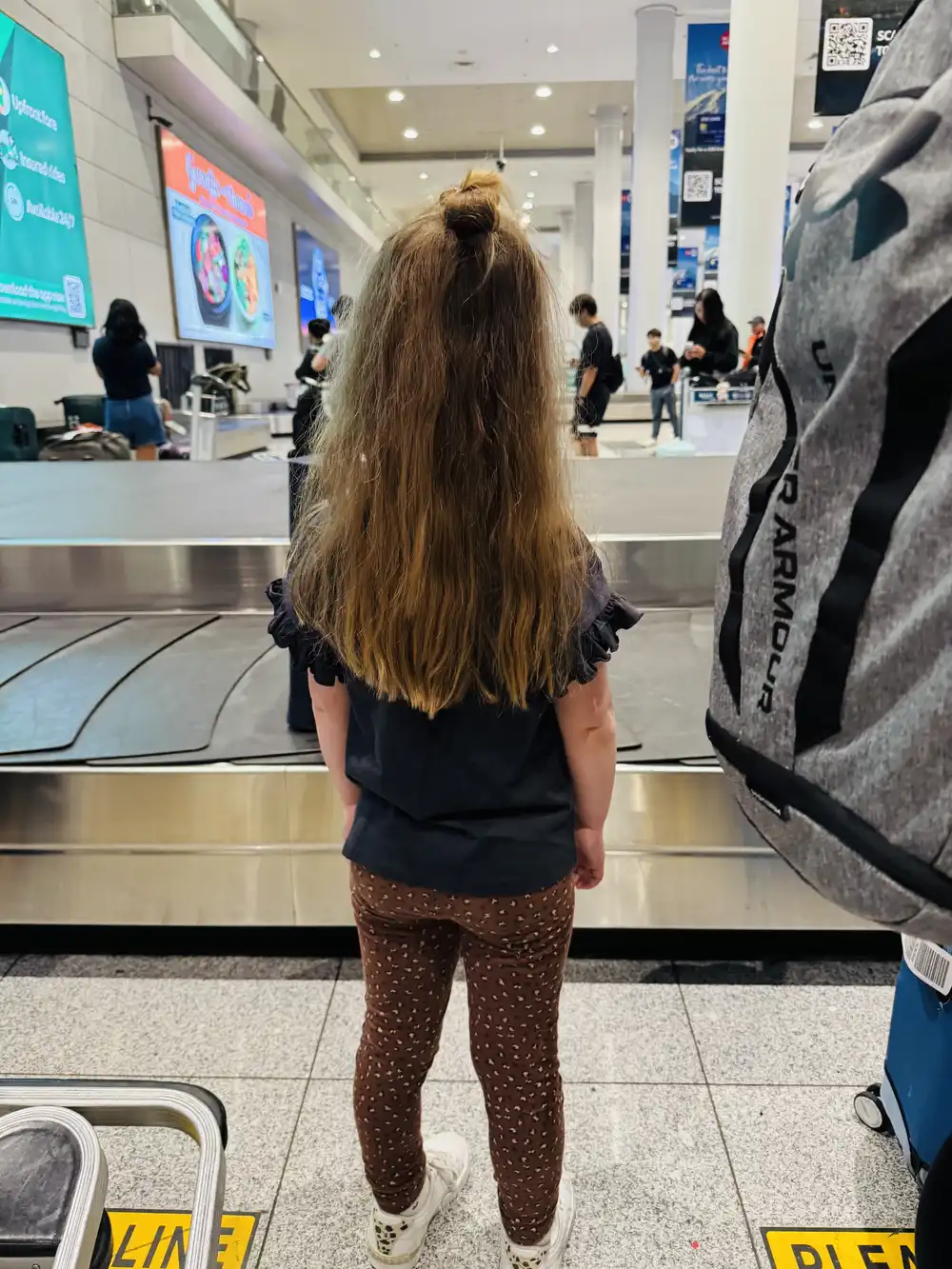
Flying with a toddler on a long haul flight is not always easy, but it also doesn’t have to feel impossible. After several long flights with our kids, we’ve learned that the biggest difference is not one perfect toy, snack, or sleep trick. It’s having a plan, staying flexible, and accepting that some parts of the flight will simply be messy.
For us, it helps to think in small steps: get through the airport, settle into the plane, handle takeoff, rotate snacks and activities, help the kids rest when they can, and keep the first day after arrival simple.
Some flights go surprisingly well, others are hard, but every trip makes you a little more confident.
So prepare well, bring the things that actually help, and don’t expect perfection. Flying with a toddler is rarely smooth from start to finish, but it can absolutely be manageable.
Need more help preparing for your flight? Read our full guide with 25 plane activities for kids or take a look at our Travel Activity Book for Kids for printable games, coloring pages, and screen-free travel activities.
Planning a family trip to Southeast Asia? You may also like our guides to:
📥 Want more tips? Visit our Family Travel Shop for printables, travel journals, and guides to make your trip smoother.
Check our socials:
Enjoy your next adventure with your family ✈️
The Little Passport Crew
There is no perfect age for flying long haul with a toddler. Younger toddlers may sleep more easily, but they also need more hands-on care. Older toddlers may understand more, but they often want to move, choose, and do things themselves. For us, the flight became easier when we stopped expecting one age to be “easy” and started preparing for the stage our child was in.
The best way to keep a toddler entertained on a long flight is to rotate activities slowly. Bring simple, low-mess options like stickers, coloring pages, small books, a few surprise toys, snacks, toddler headphones, and downloaded shows or games. We also like using screen-free travel activities, but we don’t give everything at once. Rotating activities work better than one big bag of toys
To help a toddler sleep on a plane, make the seat as comfortable as possible, dress them in comfy clothes, bring a favorite stuffed animal, and let them wind down with a book, cuddle, calm activity, or familiar show. We don’t push sleep as hard anymore. Preparing for both sleep and no sleep usually makes the flight less stressful.
For a toddler carry-on, pack snacks, a water bottle, wipes, diapers if needed, spare clothes, plastic bags, toddler headphones, a tablet, chargers, comfort items, and a few simple activities. We also like keeping changing items and spare clothes grouped together, so we can grab what we need quickly without taking the whole bag to the airplane bathroom.
Flying with a toddler can be tiring, especially on long-haul flights, but it is usually more manageable when you prepare well and stay flexible. The hardest parts are often sleep, boredom, food, and sitting still for long periods. For us, the flight feels easier when we think in small phases instead of trying to make the whole journey perfect.